Private Pay vs Insurance for Therapists: Which Is Better?

Hi, I’m Dr. Annie Krajewski. I’ve been traveling the world and running my private practice full-time.
The private pay vs insurance question is one that almost every therapist wrestles with at some point. If you're taking insurance, you might be tired of the paperwork, want more control over your rates, or are just curious if going private pay will work better for your practice.
There's no one right answer, and the best model depends on your goals, lifestyle, and the kind of practice you want to build. But there are important pros and cons to consider with both.
Personally, I've been running a fully private pay practice for over five years, and it's given me a level of freedom I didn't even think was possible, including the ability to travel the world while seeing US-based clients. More on that later!
Private pay vs insurance for therapists: At a glance
With private pay, clients pay you directly for your services. You set your rates, send invoices, and get paid. There are no insurance companies involved.
With insurance, you join panels, go through a credentialing process, and get reimbursed by insurers at predetermined rates after submitting claims for each session.
Both models can support a sustainable practice.
The difference is in how much administrative work is involved, and how much flexibility you have to design your practice around your life rather than around a system's requirements.
What is a private pay practice?
In a private pay practice, clients pay you out of pocket for each session.
You set your own rates, decide your own policies, and get paid either through your EHR or another compliant method. Some clients use HSA or FSA funds to pay for sessions, which can make them more accessible.
There are no insurance panels to join, no claims to file, and no reimbursement rates to negotiate. What you charge is what you earn.
Private pay therapists typically charge anywhere from $100 to $300+ per session, depending on their niche, experience, and specialty.
Because you're not dependent on insurance reimbursements, you also have more clinical freedom. You decide:
How long your sessions are
How often you see clients
What your cancellation policy looks like
All without needing to align those decisions with what an insurer will or won't cover.
What does it mean to take insurance as a therapist?
Taking insurance means becoming credentialed on one or more insurance panels, which are networks of providers that insurers refer their members to.
When a client uses their insurance benefits to see you, the insurer pays you a reimbursement rate for each session. That rate is set by the insurance company, not by you.
To get on panels, you go through a credentialing process that can take anywhere from a few weeks to several months. Once you're credentialed, you're bound by that panel's contract terms, which include the reimbursement rates, documentation requirements, and any review processes they have in place.
Taking insurance can make your services more accessible to clients who couldn't otherwise afford therapy. It also comes with a built-in referral stream because clients who are searching for in-network providers may find you through the insurer's directory.
But the trade-off is less control over your rates, more administrative work, and oversight from insurers that many therapists eventually find very limiting.
Personally, I’ve never accepted insurance as a therapist.
I was so burnt out from grad school, and I watched a YouTube video that talked about the hassle and headache of insurance, which made me determined not to be burnt out by yet another system that doesn’t care about my well-being.
Learn more about therapist burnout.
Private pay vs insurance: The key differences
Income and rates
With private pay, you set your rates and keep what you charge.
With insurance, reimbursement rates are set by the insurer and are often much lower than what you'd charge privately. Rates also vary by panel, by state, and can change when contracts are renegotiated, sometimes without much notice.
As your experience grows and your niche becomes more defined, private pay lets your rates grow with you. Insurance reimbursements don't work that way.
Administrative workload
Insurance billing comes with a huge administrative burden, including claims submission, clawbacks, denials, appeals, prior authorizations, and credentialing paperwork across multiple panels.
Private pay simplifies all of that. You see a client, you get paid, and the only thing you need to do after that is document the session. The time you save on billing and insurance administration can go back into your caseload, marketing, or life outside of work!
Client population
Insurance opens your practice to clients who can't afford out-of-pocket rates, which is important to many therapists. Private pay attracts clients who are willing and able to pay directly, which often means a smaller but highly motivated caseload.
Neither population is better. It just comes down to who you want to serve and what feels aligned with your goals as a therapist.
Flexibility and autonomy
Private pay gives you full control over session length, frequency, cancellation policies, and treatment decisions. Insurance panels can require diagnostic codes, limit session numbers, and audit your documentation.
Many therapists find that insurance oversight gradually chips away at their clinical freedom.
Stability and consistency
Insurance can provide a steady stream of referrals through insurer directories, which is helpful when you're building a caseload from scratch. But reimbursement rates can be unpredictable, and claims can sometimes get denied.
Plus, one thing that many therapists don’t realize is that it can take the insurance company months to pay you. You also have to meticulously track whether or not you’ve been paid, because sometimes payments get missed.
Private pay requires more proactive marketing to attract clients, but once your practice is full, your income isn't subject to insurer decisions outside of your control.
The case for private pay (my honest take!)
After running a fully private pay practice for over five years, I genuinely believe it's the better model for most therapists who want both financial sustainability and professional freedom.
But I also want to be honest about what it takes!
Private pay means:
You set your own rates
You keep what you charge
You make treatment decisions based on what's best for your client
You spend a lot less time on administrative work
You have full control over your policies
The biggest trade-off is marketing.
Private pay clients don't show up automatically. You have to put in the work to attract them. That means having a clear niche, a professional website, a strong SEO strategy, and an appealing way of communicating what you do and who you help.
For therapists who are willing to invest in that, private pay is sustainable and often more lucrative than insurance in the long run. But if you want to keep your marketing more passive, especially as you're getting started, working with an insurance provider can be helpful.
One more reason therapists choose private pay therapy: Location independence
Many private pay vs insurance comparisons don't talk about the fact that insurance panels can restrict where you practice from.
For example, some panels won't credential you if you're practicing from certain states, and practicing from outside the US can complicate or even disqualify panel participation.
With private pay, your income isn't tied to any insurer's location requirements. For most therapists, as long as you're licensed in the states where your clients are located, you can practice from anywhere.
This is how I've built my private practice! For the past three years, I've seen US-based clients via telehealth while living in Morocco, Thailand, and Indonesia.
What is a digital nomad therapist?
A digital nomad therapist is a therapist who runs a US-based practice while living or traveling internationally.
You see clients via telehealth and can build a life that isn't tied to just one physical location! You can travel between countries or settle in one place abroad for months or years at a time.
But you're seeing US-based clients in the states where you're licensed, and your private pay practice travels with you.
Learn more about how to become a remote therapist.
How private pay makes location independence possible
Insurance panels are often tied to a location.
Credentialing requirements, panel contracts, and insurer policies often create barriers that make it difficult or impossible to practice from abroad while staying in-network.
With private pay, your licensing is tied to where your clients are located, and your physical location is largely irrelevant to how your practice operates (in most cases).
If becoming a digital nomad therapist is something you're curious about, here are some guides to help you get started:
You can also contact me, and we'll chat through any questions you have!
Get my 8-step guide to build a US-based practice while traveling as a private pay therapist
Ready to take your private pay practice on the road? My free guide walks you through every step, week by week: Your 8-Steps to Become a Digital Nomad Therapist.
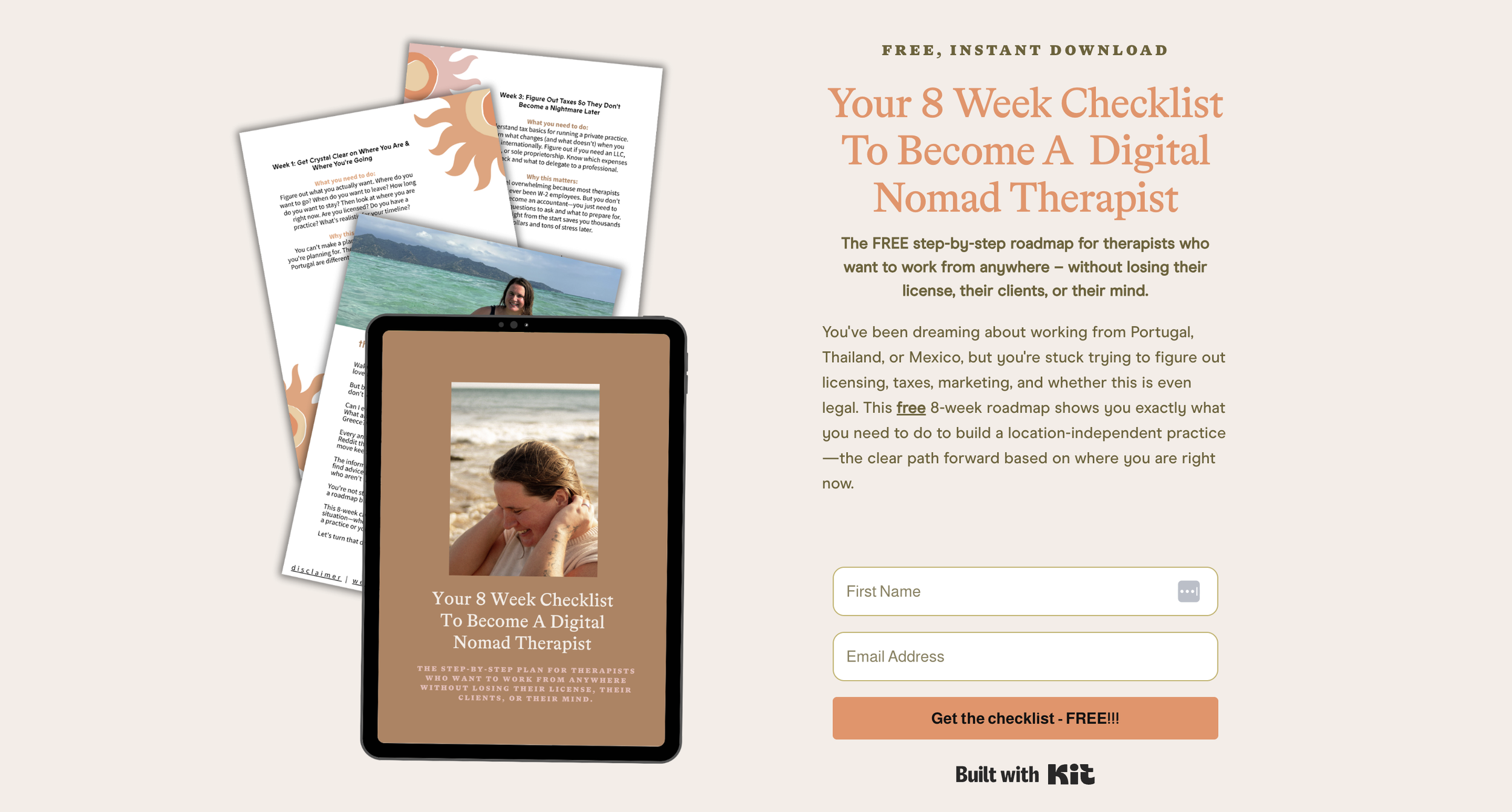
Your 8 Week Checklist to Become a Digital Nomad Therapist.
FAQs
Can I switch from insurance to private pay?
Yes! You'll need to give notice to the insurance panels that you're leaving and communicate the change clearly and professionally to your current clients. You may also want to offer referrals to therapists who take their insurance for clients who can't afford private pay rates.
Can I do both insurance and private pay?
Yes, some therapists run hybrid practices like that. This can work well as a transition strategy and give you a steady referral base while you build your private pay caseload. The downside is that you still carry all of the burdens of insurance billing for the panel clients, and you won't have the freedom of going private pay right away.
How do I find private pay clients?
I recommend niching down and building a professional website optimized for SEO that communicates a clear message that speaks to the people you want to work with. Psychology Today is also a good starting point for many therapists. Referral networks, social media, and content creation can all support your marketing over time. Private pay clients are out there!
Is it ethical to become a digital nomad therapist?
Yes! Your physical location doesn't affect the quality of care you provide. What clients care about is whether you understand their struggles and can help them make meaningful changes in their lives. If you can, most clients won't have strong feelings about where you're physically located. You're still licensed, bound by your ethical code, and providing the same standard of care. You're just doing it from another country!
Keep learning about how to build a freedom-filled, private pay therapy practice!
If building a private pay practice that gives you more freedom, including the freedom to travel, sounds like something you want, there's a lot more to explore!
Here are a few ways to keep learning about the digital nomad therapist lifestyle:
Subscribe on YouTube for content on building a location-independent private pay practice
Connect on Instagram to join a community of like-minded therapists
Get in touch if you have questions or want to talk through your situation
You don't have to choose between a thriving practice and a life full of experiences! Private pay makes both possible.