How to Become an International Therapist in 5 Steps
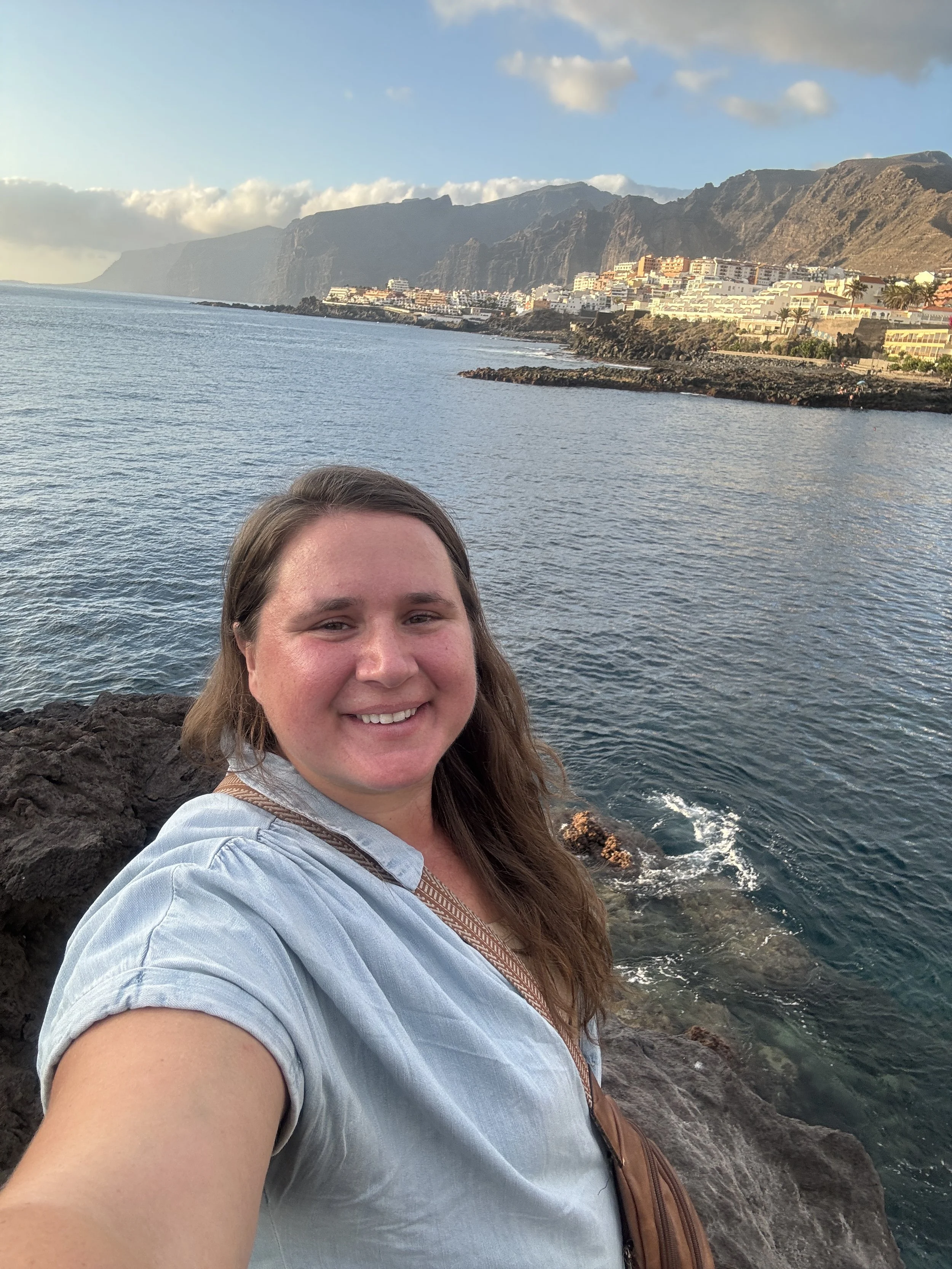
Hi, I’m Dr. Annie Krajewski. I’ve been traveling the world and running my private practice full-time for 3+ years!
Learning how to become an international therapist and building a life that doesn't revolve around a single office might feel like an impossible dream.
Working from Europe? Seeing clients from a beachside apartment in Mexico? It sounds incredible, but also overwhelming and complicated.
I get it, because I felt the same way before I made the leap! After building a successful US-based private therapy practice while living and working from Morocco, Thailand, and Indonesia, there's one thing I know for sure:
Becoming an international therapist is totally doable, but it's important to understand your options and choose the route that fits your goals.
Here's a guide that walks you through everything that you need to know!
What does it mean to become an "international therapist"?
An international therapist is someone who works as a mental health professional outside their home country or serves clients across international borders. But there's no single definition. Different therapists take different routes to make this happen.
For example, you may:
Work for a mental health organization abroad
Join a telehealth platform and see clients remotely
Move to another country and build a local practice there
Maintain a US-based private practice while physically living in other countries (like me!)
All of these are "international" career paths that you may consider as a licensed psychologist or therapist. But each has different requirements, trade-offs, and levels of flexibility.
Let's take a closer look at all of these options:
Work for an international organization or school
To follow this path, you'll need to get hired by an organization that operates internationally and needs mental health professionals on staff. Examples include:
International schools
NGOs
Military or government programs
Humanitarian organizations
Multinational corporations
You'd typically work as an employee with a set salary, benefits, and a visa sponsored by your employer. The organization would most likely handle all of the logistics of your work authorization.
This can be a stable option if you want structure and don't want to manage your own business. But it limits where you can work (you go where the job takes you), and you're tied to that employer's location and contract terms.
Learn more about how psychologists can travel the world.
Join a telehealth platform
Platforms like BetterHelp, Talkspace, and similar companies connect therapists with clients for remote sessions. You sign up, get matched with clients, and see them virtually from wherever you're located.
This option gives you some flexibility to work remotely, but it comes with pretty big limitations:
You're typically paid less than what you'd earn in private practice
You get matched with clients and often have minimal say in who you work with
Depending on the platform's policies, you may face restrictions on where you can practice from
If you want full location independence and the freedom to design your practice, telehealth platforms usually aren't the best fit. But they can sometimes be a good place to start!
Practice locally in another country
You can move to another country and build a therapy practice there, seeing clients who live in that country. However, this is often the most difficult and unrealistic option for US-trained therapists.
Why? Because to practice legally in most countries, you need to meet that country's licensing and education requirements. This usually involves:
Having your credentials evaluated (and often deemed insufficient)
Completing additional coursework or even a full degree program at a local university
Gaining supervised clinical hours in that country
Passing licensing exams in the local language
Navigating that country's healthcare and insurance systems
The process can take years and cost tens of thousands of dollars, with no guarantee that your US training will be recognized.
For most therapists, this path isn't practical unless you're committed to permanently relocating and willing to invest a lot of time and money into re-credentialing.
Learn more about working in Europe as a US therapist.
Build a US-based practice from abroad
This is the setup I have, and it's the option that gives you the most freedom and flexibility! This way, you:
Keep your US license
Continue seeing US-based clients through telehealth, and
Live wherever you want internationally
You don't need additional education or licensing in your host country because you're not seeing clients there. You're running a US business from abroad.
This path lets you maintain your income, keep the practice you've built, and travel or relocate without starting over. You're also not locked into one location or dependent on an employer.
That said, becoming a travel therapist this way does require quite a bit of planning.
You need to understand licensing rules, set up your systems correctly, and manage logistics like visas, time zones, and taxes.
But compared to the other options, it's the most realistic and achievable for therapists who want to work internationally without giving up their freedom OR income!
How to become an international therapist with a US-based private practice: 5 steps
1. Research your licensing board's rules on provider location
Most state licensing boards care about where your clients are located during sessions, and not where you are. But that's not always the case, and the rules vary by state.
Start by reviewing your state's telehealth laws and regulations. Look for any language about provider location or restrictions on practicing from outside the US. Many states have straightforward rules that let you practice from any location as long as your clients are in states where you hold a license.
If the regulations don't clearly address this, email your licensing board and ask whether you can see clients in your licensed state while you're physically in another country. Keep a record of their answer for your files!
If your state restricts provider location, you still have options. You can get licensed in additional states that have more flexible rules and build your practice there before you leave.
It takes time and costs money to add licenses, but it's worth it if becoming a remote therapist is your goal.
2. Set up your business
Your business structure affects your taxes and legal protection.
If you're just starting out, an LLC is usually a good option. Once you're earning more, you can often switch to S-Corp taxation for potential tax savings.
Remember that even if you're living abroad, your business is US-based.
This means that you'll need to maintain a US business address for official correspondence. You can use a registered agent service or a trusted contact's address for this.
You'll also need to file your US business taxes every year, just like you would if you were living in the US. Your tax obligations don't change because you're abroad, and you're still running an American business.
Learn more about how to legally become a travel therapist.
3. Figure out liability insurance
Not all malpractice insurance policies cover telehealth, especially if you're practicing from outside the US, but it's still very possible to find good options.
When shopping for liability insurance, ask:
Does your policy explicitly cover telehealth services?
Does coverage extend to your physical location if you're practicing internationally?
Are there any exclusions or additional requirements for remote work?
It's possible to find an insurer who will cover you abroad with no issue. But sometimes, you may need to pay a higher premium, and a few providers won't cover international locations at all.
If you don't find a good option right away, keep researching! The right policy is out there.
4. Set up your tech + workspace
Your technology needs to be HIPAA-compliant and work reliably from wherever you're located. At the very least, you'll need:
EHR platform: Choose one that allows international login access. I recommend Jane for therapists working abroad, and you can use my code DIGITALNOMAD1MO to get one month free!
Video platform: Zoom works well in most countries and handles slower internet connections better than some other options. It also blocks out background noise.
VPN: Use a VPN to protect your internet connection, especially when you're on shared or public wifi. This helps you stay HIPAA-compliant.
Payment processing: Confirm that your payment processor works from your location.
US phone number: Keep a US-based phone number even when you're out of the country.
Your workspace is also very important! You need a private, professional space where no one can overhear your sessions. If you're traveling and using Airbnb, book accommodations where you can create that kind of space.
I also recommend using a laptop instead of an iPad for stability, getting a laptop stand so your camera is at eye level, and investing in quality headphones.
5. Research visa requirements
You may need to get a visa, depending on whether you want to move long-term to a single country or travel between multiple countries.
Short-term travel: Americans can typically stay in most countries for up to 3 months without a visa. If you're moving around a lot, you may not need a visa at all.
Long-term stays: If you want to live in one country long-term, you'll most likely need a long-term visa. Many countries, such as Portugal, Greece, and a few Latin American countries, now offer digital nomad visas for remote workers!
Keep in mind that Europe tends to have stricter visa requirements. Countries in Asia and Latin America are often more flexible and easier to navigate for long-term stays.
Also, you most likely won't qualify for a work visa in a foreign country if you're running a US-based private practice. These visas usually require employer sponsorship, which doesn't apply if you're self-employed. Digital nomad visas are usually your best bet.
Get my 8-week checklist to build a US-based private practice
There are more steps to building a location-independent practice than I can realistically cover in a single blog post. If you want the complete roadmap, download my free guide: Your 8-Week Checklist to Become a Digital Nomad Therapist!
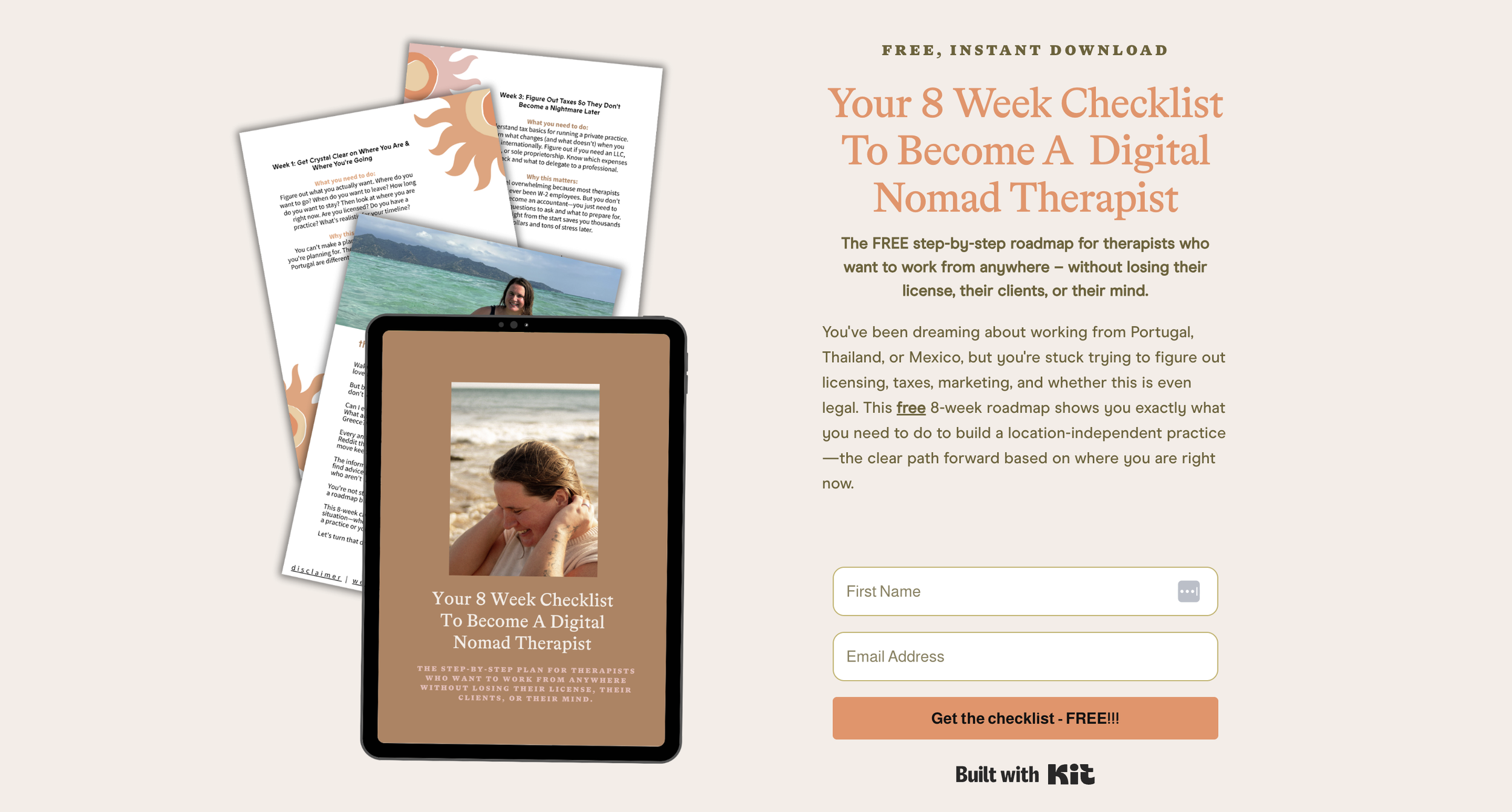
Your 8 Week Checklist to Become a Digital Nomad Therapist.
Is becoming an international therapist realistic and ethical?
This is one of the most common concerns I hear from therapists, and I understand why. Traveling the world while maintaining a full caseload? It sounds too good to be true. But after running my own private practice while living abroad for 3+ years, I can tell you that it's definitely possible!
So, is it realistic? Yes. There are logistics to figure out, such as licensing rules, liability insurance, and visas. But none of these are insurmountable. Many therapists have figured it out, and you can too. You just need to do some research and planning!
Is it ethical? Also yes. Most clients don't care where you're physically located as long as you're a good therapist who can help them with their problems. What matters to them is whether you can help them make meaningful changes in their lives. Your physical location doesn't affect your ability to do that.
The bottom line is, you get to do your best work as a therapist AND live a life you truly enjoy. It's realistic and ethical to have both!
FAQs
Do I need to be licensed in the country where I'm located?
No, not if you're seeing US-based clients. Your license needs to match where your clients are located, not where you are. If you're running a US-based practice and all your clients are in states where you're licensed, you typically don't need a local license in your host country. That said, always verify with your state licensing board, as rules can vary!
Can I still take insurance as an international therapist?
It's complicated. Some insurance companies won't credential you if you're practicing from certain states or if they discover you're physically located outside the US. Many international therapists run private pay practices for this reason. It eliminates location restrictions and administrative headaches. If insurance reimbursement is important to you, check with individual panels about their provider location policies before making the move.
What if I want to return to the US or move to a different country?
Your practice moves with you! Since your business is US-based and your clients are in the US, you can return home or relocate to another country without disrupting your caseload. You'll need to research visa requirements for each new country, but your therapy practice itself stays the same. Many digital nomad therapists move between countries regularly.
Get more answers on how to become an international therapist
Becoming an international therapist is possible, and there are multiple ways to make it happen! But the path that gives you the most freedom is building a US-based practice while traveling or living in another country.
That said, figuring out how to do that is definitely confusing when you're in the planning stage. You probably have questions like: Which states should I get licensed in? How do I stay HIPAA-compliant? What the heck do I tell my clients?!

You don't have to figure it all out alone.
The Out of Office Therapist Village is a 12-month membership that gives you step-by-step guidance on building a US-based therapy practice while traveling or living abroad.