How to File Taxes as a Digital Nomad Therapist

Hi, I’m Dr. Annie Krajewski. I’ve been traveling the world and running my private practice full-time for 3+ years!
Living as a digital nomad therapist sounds incredible. Who doesn't want to explore Bali or Thailand between client sessions? But then taxes come up, and suddenly, building a private practice that travels with you starts to feel way too complicated.
So, how to file taxes as a digital nomad therapist? Do you have to file where your business is registered? What about the country you're living in? Can you deduct your coworking space?
As a therapist who runs a US-based private practice while living abroad, I know that taxes are one of the biggest anxiety triggers for digital nomad therapists, or therapists considering this lifestyle.
But staying compliant IS possible! Here's how.
Quick disclaimer: I'm not a tax expert or accountant. What I'm sharing here comes from my personal experience and the guidance I've received from my own tax professional. For your specific situation, always consult with a qualified tax advisor.
Do digital nomad therapists have to file taxes?
Yes! And there are multiple “levels” to consider for US citizens. Most likely, you'll have to pay:
Business taxes
Personal taxes
Taxes in the foreign country where you're living (potentially)
As a US citizen, you have tax obligations in the US regardless of where in the world you're physically located. You could be in Seattle or in Lisbon, and the IRS still requires you to file and pay taxes on your worldwide income.
So, how does paying taxes as a digital nomad therapist work? Let's break down each tax category so you understand what applies to your situation.
Business taxes
If you have a US-based private practice, you need to file US business taxes. This doesn't change just because you're living abroad.
Where it might get different: some of your business expenses will be in foreign currencies or purchased in other countries. For example, if you buy a desk in cash at a furniture market, you'll need to track that expense and convert it to US dollars when you file.
So, make sure to keep all receipts!
(Well, if you can get them…Once, a street vendor in Morocco gave me a funny look when I asked for one. Just do your best!)
Federal taxes
Your business structure determines how you file federal taxes.
For example, if you're a sole proprietor, you'll report your business income and expenses on Schedule C of your personal tax return. If you have an LLC taxed as an S-corp, you'll file a separate business return (Form 1120-S) and pay yourself a reasonable salary through payroll.
Self-employment tax is also a big part of this. When you work for yourself, you pay both the employer and employee portions of Social Security and Medicare taxes. That's 15.3% on your net earnings. This applies whether you're in the US or abroad.
Quarterly estimated taxes are usually required if you expect to owe $1,000 or more in federal taxes for the year. You'll make these payments in April, June, September, and January based on your projected income. Again, living abroad doesn't change this requirement.
In other words, your federal tax obligations stay mostly the same when you're living abroad.
You're still filing the same forms, following the same deadlines, and meeting the same requirements as therapists based in the US.
Learn more about the ways to legally become a travel therapist.
State taxes
As a digital nomad therapist, you also still have state tax obligations.
What they are will depend on your state's rules. For example, some states (like Florida, Texas, and Washington) don't have income tax at all. Others will continue taxing you even after you move abroad.
Personally, my private practice is registered in Virginia, which is where I pay business taxes for my LLC.
But your situation will look different depending on where you established your practice and where you maintain legal residency. Some states let you become a non-resident once you've lived abroad for a certain period, which can reduce or eliminate your state tax obligations.
The bottom line is to check your state's rules!
Personal taxes

Dealing with taxes feels a lot better when this is your afternoon break view!
All US citizens and permanent residents need to file personal tax returns and pay taxes on their worldwide income, no matter where they live or earn that income.
If you're a digital nomad therapist living in Thailand, Europe, or anywhere else, you still file a US personal tax return every year.
Your personal return includes all your income. For example, you may need to report:
What you earned from your therapy practice
Investment income
Rental income
Other sources
You'll file Form 1040 and report everything in US dollars, even if you earned it in euros or another currency.
Living abroad does come with some potential tax benefits. For example:
Foreign Earned Income Exclusion (FEIE) lets you exclude a certain amount of foreign earned income from US taxes if you meet specific requirements, like living outside the US for at least 330 days in 12 months.
Foreign Tax Credit can help offset US taxes if you're paying income tax in another country.
These provisions can reduce your US tax bill, but they come with rules and requirements. A tax professional can help you determine if you qualify and how to claim these benefits correctly!
Taxes in a foreign country
Depending on how long you stay in a foreign country, you may become a tax resident there and have obligations to pay local taxes. Many countries consider you a tax resident if you stay longer than 183 days (roughly six months) in a calendar year, but the exact rules vary by country.
If you get a digital nomad visa, tax requirements are often built into the visa terms. For example, some countries require you to pay taxes at a reduced rate as part of your visa agreement. But in exchange, you often get access to services like public healthcare and social benefits.
It's a good idea to connect with an accountant or tax advisor in the foreign country where you're living, especially if you're staying long enough to trigger tax residency.
Learn more about how to become a remote therapist.
How can I avoid double taxation as a digital nomad therapist?
"Double taxation" is when you owe taxes on the same income in two different countries.
As a US citizen or permanent resident, you're at risk for this because you owe US tax on your worldwide income, but if you live in another country long enough, that country may also tax you on what you earn.
Fortunately, there are provisions that can help reduce or eliminate double taxation.
Your options usually include:
Foreign Earned Income Exclusion (FEIE): This lets you exclude up to $132,900 (for 2026) of foreign earned income from US taxes if you meet certain requirements, like being outside the US for at least 330 days in 12 months.
Foreign Tax Credit: If you pay income tax to a foreign country, you can claim a credit on your US return for those taxes, which reduces your US tax bill dollar-for-dollar.
Tax treaties: Some countries have agreements with the US that prevent double taxation or reduce tax rates on certain types of income.
Double taxation concerns usually come up if you live in a foreign country for the majority of the year or full-time. If you're just traveling for a few weeks or moving around frequently without establishing tax residency anywhere, it usually doesn't apply.
But if it does apply to your situation, consult with a tax professional who can help you navigate both systems!
Learn more about how psychologists can travel the world.
Can I claim any tax deductions as a digital nomad therapist?
Yes! Many of your business expenses are deductible, just like they would be if you were living in the US.
For example, you can usually deduct:
Home office expenses: A portion of your rent, utilities, and internet, based on the percentage of your home used for work.
Technology and software: Your EHR subscription (I highly recommend Jane, and you can use the code DIGITALNOMAD1MO to get 1 month free!), video platform, VPN, website hosting, and equipment like laptops, headphones, or a ring light.
Continuing education: Courses, certifications, and conferences (even if they're virtual).
Professional services: Liability insurance, accounting fees, legal fees, and business coaching.
Office supplies and furniture: Items you buy abroad, converted to US dollars.
Business travel: Travel expenses for conferences or workshops (but not personal travel while living abroad).
Keeping records of your expenses while living abroad can be a little more complicated, though.
Some countries are more cash-based, which makes it harder to get receipts. Converting from foreign currencies can feel confusing, too. But you do have the right to claim these deductions, and a tax professional can help you figure out the logistics!
Should I consult with a tax professional?
Personally, I highly recommend doing that!
It's an extra fee, but it can save you a ton of money on taxes and give you peace of mind that you're staying compliant, especially when you're dealing with multiple tax systems.
For your US taxes, work with a CPA or tax advisor who has experience with expat or international tax issues.
If you're staying in a foreign country long enough to become a tax resident (usually six months or more), it's also worth consulting with a local accountant in that country.
Just make sure that your tax strategy in one country doesn't create problems in another!
Sometimes, trying to maximize tax benefits on one side can accidentally trigger issues on the other. Before committing to anything, make sure to check with both of your tax professionals and get a green light.
Learn more about the 5 things I wish I knew before becoming a travel therapist.
The 4 legal questions every therapist must answer before moving abroad
Does figuring out the legal side of your private practice feel overwhelming? My free guide walks you through the licensing, insurance, and regulatory questions you'll need to answer before you move abroad.
Download The 4 Legal Questions Every Therapist Must Answer Before Moving Abroad, and get clarity on what you need to handle before you pack your bags!
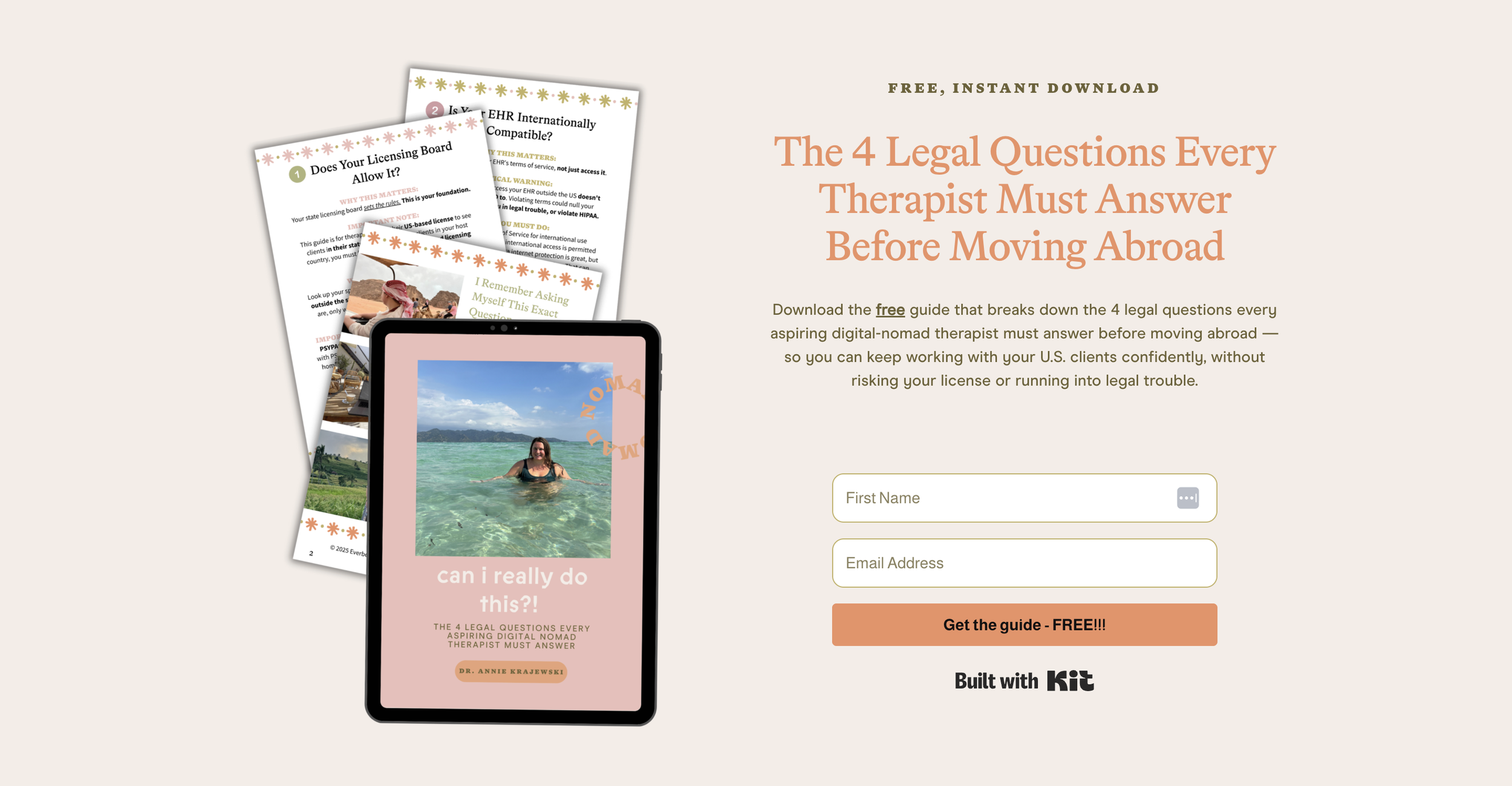
The 4 Legal Questions Every Therapist Must Answer Before Moving Abroad.
FAQs
Do I still have to pay US taxes if I'm living abroad as a digital nomad therapist?
Yes! US citizens and permanent residents must file US tax returns and pay taxes on their worldwide income, even if they live in another country. You may qualify for tax breaks like the Foreign Earned Income Exclusion or Foreign Tax Credit, which can reduce what you owe, but you still need to file. This requirement doesn't go away just because you're not physically in the US.
Do I have to pay quarterly estimated taxes as a digital nomad therapist?
Usually, yes, if you expect to owe $1,000 or more in federal taxes for the year. Quarterly estimated taxes are due in April, June, September, and January, and you'll base your payments on your projected income for the year. Living abroad doesn't change this requirement. You're still self-employed and responsible for paying estimated taxes throughout the year!
If I earn income in a foreign currency from international clients, how do I report that?
You'll need to convert all foreign currency income to US dollars when you report it on your tax return. The IRS provides daily exchange rates on their website, or you can use a reliable financial source. You'll report the converted amounts on your tax return just like you would any other income.
Want to become a digital nomad therapist?
Building a remote, location-independent private therapy practice can be confusing on so many different levels, in addition to taxes!
You may have questions like:
Which states should you get licensed in, and can you practice from abroad?
Does your malpractice policy cover you when you're physically located in another country?
How do you schedule clients when you're 6-9 hours ahead of US time zones?
What platforms and tools do you need to stay HIPAA-compliant while traveling?
Do you need to tell your clients you're abroad, and how do you handle that conversation?
It's easy to feel overwhelmed, but you don't have to figure it out alone!

The Out of Office Therapist Village is a 12 month membership that gives you step-by-step guidance on how to build a private therapy practice that allows you to travel the world!