Can a US Therapist Work in Europe? Yes, But...

Hi, I’m Dr. Annie! I’m a US therapist who built a fully remote private practice while traveling the world (including Europe!).
Can a US therapist work in Europe? As a digital nomad therapist, I get asked this question very often, and the answer is yes, but with an important caveat.
There are two very different paths you could take: becoming licensed to practice in a European country, or maintaining your US-based practice while living abroad.
The first option is usually too difficult and time-consuming for most American therapists. But the second option is a lot more realistic and doable.
Personally, I've built a remote, private-pay therapy practice while living abroad, and all my clients are US-based.
So, can mental health professionals move to an EU country and work there? Here's what you need to know!
Can a US therapist work in Europe? The short answer
Yes, you can work as a therapist while living in Europe. But you need to understand that there are two main paths available:
Path 1: Get licensed as a therapist in a European country to see European clients. This is usually difficult, expensive, and takes years.
Path 2: Keep your US license and practice, see US clients remotely, and live wherever you want in Europe. This is the more realistic option for most therapists.
Let's break down both so you can figure out which one (if either) makes sense for your situation.
You can also learn more about the exact steps I took to build my private therapy practice in a way that allows me to travel the world while seeing US-based clients!
Path 1: Becoming a licensed therapist in Europe
This path appeals to therapists who want to permanently relocate to Europe and build a practice serving European clients.
Many therapists and mental health counselors assume that their US credentials will transfer relatively smoothly, but the reality is that, most of the time, they won't.
Each European country has its own licensing requirements, and most don't recognize US mental health degrees or licenses without significant additional work.
The American Psychological Association notes that "while American-trained psychologists tend to be in high demand for overseas academic jobs, finding work as a clinician can prove more challenging."
To work in Europe as a US therapist seeing European clients, you'll usually need:
Credential evaluation: Your US education gets evaluated, and it's often deemed insufficient by European standards.
Additional education: Many countries require you to complete additional coursework or even a full master's program at a local university.
Language proficiency: You'll likely need professional-level fluency in the country's primary language, such as Spanish, Italian, or Portuguese.
Supervised clinical hours: You'll need to complete supervised practice hours within that country, which means finding supervision and possibly working for little to no pay.
Licensing exams: You'll take exams in the local language that test your knowledge of that country's mental health system, insurance structures, and legal frameworks.
Insurance and regulatory systems: You'll need to understand how mental health care is funded, what treatments are covered, and how to navigate a new bureaucracy.
Different European countries have different requirements for therapists, and some are less strict than others.
But generally speaking, you're looking at a pretty lengthy and expensive process with no guarantees, so this is something that very few US therapists actually end up doing.
What about calling it "coaching" or "counseling"?
Some therapists consider offering services under a different title to avoid licensure requirements. You could potentially market yourself as a coach or counselor rather than a therapist.
But many European countries are strict about mental health terminology and who can provide what services. You'd likely be limited to working with international clients or expats, and even then, you're navigating gray legal areas. Proceed with caution and legal advice!
Path 2: Maintain a US-based practice while living in Europe
This is what I do as a travel therapist, and it's the most realistic option for therapists who want to live abroad without completely rebuilding their career.
You keep your US license and credentials, continue serving US clients through telehealth, and physically live wherever you want in Europe (or anywhere else in the world). There are no additional education or licensing requirements!
The benefits include:

Imagine doing this after you finish seeing your clients for the day!
Keep your established practice and income: You don't have to start from scratch or interrupt your earning potential.
Flexibility to move between countries: You're not locked into one location and can explore different European countries or move as your visa requirements dictate.
Lower cost of living in many places: Your US income often goes further in countries like Portugal, Spain, Greece, or Eastern Europe, giving you a higher quality of life.
Travel within Europe: Living in Europe gives you easy access to weekend trips and exploration when you're not seeing clients.
Naturally, building a US-based, remote therapy practice while living in Europe isn't without its challenges:
Time zone differences: Depending on where you are in Europe, you might need to see clients early in the morning or late at night.
Potential loneliness or isolation: You won't have a local professional community unless you actively seek it out.
Managing US administrative tasks from abroad: Banking, taxes, mail, and phone calls with insurance companies can all get more complicated when you're in a different country.
This is the path I've taken! I don't live in Europe, but I've lived in Morocco, Thailand, and Indonesia while maintaining a full US-based caseload. It's absolutely doable, but it requires planning and systems.
Here are the 5 things I wish I knew before becoming a travel therapist.
How to build a US-based private practice while living abroad in European countries
1. Look at visa options
Americans can typically stay in European countries for 90 days out of every 180 days without a visa. If you want to stay longer than that, you'll need to navigate the visa process.
Some European countries, such as Spain, Greece, and Portugal, now have digital nomad visas for remote workers. That includes therapists who see clients online! They require proof of income and health insurance, but the application process is usually more straightforward than traditional visa routes.
Work visas are another option, but they're typically harder to get because they require employer sponsorship. Since you're self-employed with a US-based practice, work visas usually don't apply.
2. Research your state board's rules about provider location
If you want to work abroad, confirm that your licensing board allows you to practice from outside the US.
Most state boards care about where your clients are located during sessions, not where you're physically sitting. But not all states have clear rules about this, and a few explicitly restrict international practice.
If you can't find anything or the rules are vague, email your licensing board and ask them: "Can I provide telehealth to clients in [your state] while I'm physically located in Europe?"
If your state doesn't allow it, you can get licensed in states with more flexible rules about provider location and focus on building your practice there before you leave.
3. Contact your liability insurance
Your malpractice insurance might not automatically cover you when you're practicing in another country.
Email your insurance provider and ask: "Does my policy cover me if I'm physically located in Europe while providing telehealth to US clients?"
(Email, not call! As the TikTok lawyers have taught me, leave a paper trail!)
Some insurers say yes with no issue. However, you may need to pay a higher premium, and a few providers won't cover international locations at all.
If your current policy doesn't cover you abroad, don't get discouraged! Many providers do, and it's typically a pretty straightforward switch.
Learn more about how to legally become a travel therapist.
4. Set up your tech stack for international work
Your technology needs to be HIPAA-compliant and work reliably so you're able to provide high-quality care to your clients online. Here's what you need:
EHR access: Confirm that your electronic health records platform allows international logins. I recommend Jane as my EHR of choice!
Video platform: Zoom works in most countries and handles lower internet speeds better than some alternatives. It's also great at blocking out noise, like traffic or dogs barking outside.
VPN: Use a VPN to encrypt your internet connection, especially if you're on shared wifi. This keeps you HIPAA-compliant and protects client information.
It's also important to create a private, intentional space for seeing clients. This doesn't mean you need a dedicated home office or that you always have to be in the same location, but you do need privacy and professionalism.
Make sure that no one can overhear your sessions, use a laptop stand so your camera is at eye level, invest in quality headphones, and check your lighting!
5. Start planning time zones and scheduling
Time zones are often one of the biggest logistical challenges of running a US practice from Europe.
Europe is typically 5-9 hours ahead of US time zones, depending on where you are and which US state your clients are in. That means if you want to see clients during their evening hours (6-9 pm their time), you're working late into your night (11 pm-2 am or later).
Here's what can help:
Focus on clients in US time zones that create more manageable hours for you
Offer morning and midday availability for US clients, which falls in your afternoon/evening
Use scheduling software that automatically converts time zones
You may not have the "normal" work hours, but you have the freedom and autonomy to design your own schedule. This is what running your own private practice is all about, right?
Get My 8-Week Checklist to Become a Digital Nomad Therapist
Ready to start building your location-independent practice? My free guide walks you through the steps to take your practice abroad, including the legal requirements, figuring out how to pay taxes, navigating the clinical side, and more.
Download Your 8-Week Checklist to Become a Digital Nomad Therapist and get the week-by-week plan for setting up your remote practice!
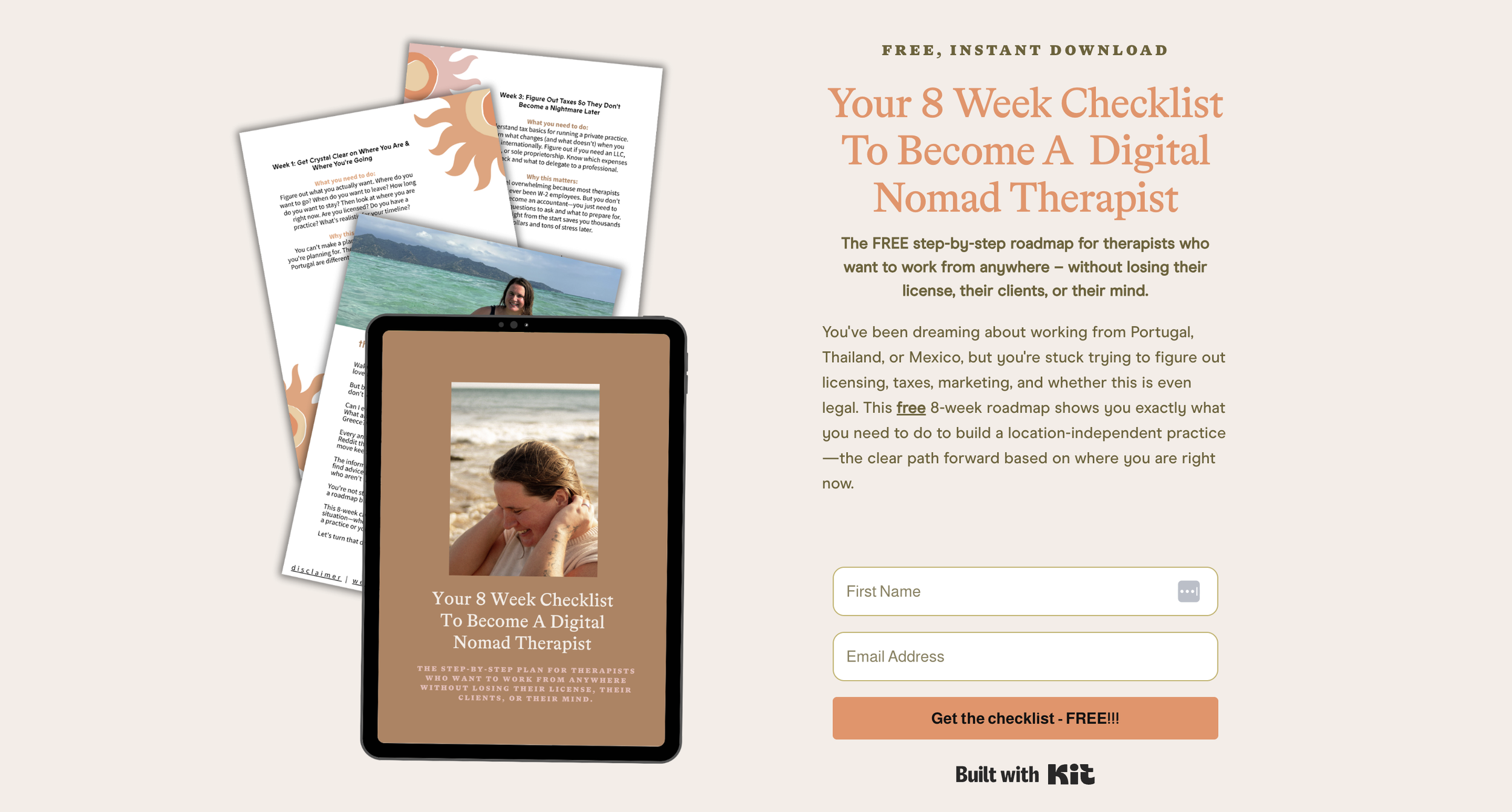
Your 8-Week Checklist to Become a Digital Nomad Therapist.
FAQs
Can US therapists see clients in Europe?
No, US therapists generally can't see clients who are physically located in Europe unless they're licensed in that European country. Your US license only allows you to practice in the US states where you're credentialed. It doesn't extend to European clients, even if you're providing services remotely.
However, US therapists can see US-based clients while they themselves are physically living in Europe. Your clients stay in the US states where you're licensed, and you provide telehealth services from wherever you're located abroad. The location of your clients determines where you need licensure, not your own location.
Can an American therapist practice in Germany?
If you want to practice as a licensed therapist in Germany and see German clients, you'll need to meet Germany's licensing requirements. This typically means having your credentials evaluated, completing additional education (often in German), passing German licensing exams, and navigating their mental health system.
You can live in Germany while maintaining your US-based practice and seeing US clients remotely, but you'd need to secure the appropriate visa that allows you to stay in the country long-term.
Can Americans work remotely in Europe?
Yes, Americans can work remotely in Europe, but you need to make sure that you have an appropriate visa and legal standing in the country. For a short-term visit, you can stay in most European countries for up to 90 days out of every 180 days without a visa. Beyond that, a few EU countries now offer digital nomad visas and allow Americans to live there legally while working for non-European employers or clients.
Will my US clients care that I'm in Europe?
Most won't! If you're providing the same quality of care, your physical location doesn't affect the therapeutic relationship. What clients care about is whether you understand their struggles, stay present during sessions, and help them make tangible changes in their lives.
Want to run a US-based therapy practice while living in other countries? Join The ooo therapist village!
So, can you live in Europe and work as a US therapist? Yes!
But for most providers, the most realistic path is maintaining your US practice while living abroad. It requires planning, sure, but it's 1000% doable, and you don't have to choose between your career and the life you want.

The Out of Office Therapist Village is a 12-month group membership for therapists who want to build location-independent practices.
You'll get step-by-step guidance on navigating licensing, setting up your systems, managing time zones, and creating a practice that works from anywhere in the world. Plus, you'll join a community of therapists on the same journey.