Can Psychologists Travel the World? 8 Cool Career Paths
Can psychologists travel the world? Yes, and there are many different ways to do it! Depending on your specialty, you can take occasional work trips or even reach complete location independence and live in different countries all around the world.
Some of the main options for becoming a traveling psychologist include clinical psychology, school psychology, forensic psychology, organizational consulting, research, or running your own private practice.
Personally, I've been running my private practice while living abroad in Morocco, Thailand, and Indonesia for 3+ years, and it's absolutely something you can do too, whether you're still in school or looking to shift your current career.
Let's take a closer look at your options!
Can you be a traveling psychologist?

Hi, I’m Dr. Annie Krajewski. I’ve been traveling the world and running my private practice full-time for 3+ years!
Yes! Psychologists can travel the world, but how you do it largely depends on your specialty and career path.
Not all psychology careers are created equal when it comes to travel flexibility.
In some roles, you might travel occasionally for conferences, training, or short-term assignments. In others, you can have full location independence, living and working from pretty much anywhere with reliable internet.
The average annual pay for a traveling psychologist in the US is $92,813 a year, but this number can look different depending on your specialty, experience level, and whether you're employed by an organization or running your own practice.
Curious? Take a look at my day in the life as a travel therapist!
Can you travel while being a psychologist? 8 amazing career paths to see the world
Multiple psychology career paths allow for travel. We're going to cover:
School psychologist
Forensic psychologist
Industrial/organizational psychologist
Research psychologist
International NGO or non-profit work
Government and military psychologist
Telehealth psychologist
Private practice psychologist
All of these roles are in high demand, but some give you more agency and opportunities to work abroad than others.
1. School psychologist
Travel potential: Low to medium.
School psychologists work in educational settings, conducting assessments, providing counseling to students, and developing intervention plans for kids who need extra support.
This is more common in the US than in other countries. You can often take short-term contracts in different districts or states, which allows you to move around and see different parts of the country.
If you want to work in another country, you can explore positions at international schools abroad. However, you're tied to the school's location and academic calendar. You may also have to deal with local licensing requirements depending on the school’s setup.
Pros: Stable income, clear work schedule, summers off in many positions, and the opportunity to work at international schools in countries like Japan, Spain, or the UAE.
Cons: You're location-dependent once you accept a position, limited flexibility during the school year, and you often need to meet state or country-specific licensing requirements.
The average annual pay for a school psychologist in the US is $92,813 a year.
2. Forensic psychologist
Travel potential: Low to medium.
Forensic psychologists work at the intersection of psychology and the legal system.
You might conduct psychological evaluations for court cases, assess competency to stand trial, provide expert testimony, work with incarcerated populations, or consult on criminal investigations (Criminal Minds, anyone?).
Pros: Unique and intellectually challenging work, opportunities for consulting that can include travel, and competitive pay.
Cons: Most roles are within the US (not abroad), require working within government or institutional systems, and come with irregular hours.
The average annual pay for a forensic psychologist in the US is $87,877 a year.
3. Industrial/organizational psychologist
Travel potential: Medium to high.
Industrial/organizational (I/O) psychologists work with businesses and organizations to improve workplace dynamics, employee performance, hiring processes, and organizational culture. You might do leadership assessments or consult on team effectiveness.
If you build your own consulting practice, you can have a lot of control over where and when you travel.
Pros: High earning potential, flexibility if you're consulting independently, and opportunities to work with diverse companies and industries, both in the US and abroad.
Cons: Consulting work can be unpredictable, you might spend a lot of time traveling for short periods rather than living abroad long-term, and it's a competitive field.
The average annual pay for an industrial/organizational psychologist in the US is $92,813 a year.
4. Research psychologist
Travel potential: Medium.
Research psychologists design and conduct studies to advance understanding of human behavior, cognition, mental health, or other areas of psychology. You might work for a university, research institute, government agency, or private organization.
If you want to work abroad, it's often possible to secure a job at a university abroad because, as the American Psychological Association notes, "American-trained psychologists tend to be in high demand for overseas academic jobs."
Pros: Intellectually stimulating work, opportunities to work internationally, conference travel, potential for sabbaticals or research trips abroad.
Cons: Most positions require you to be based at a specific university or institution, and funding can be unpredictable.
The average annual pay for a research psychologist in the US is $99,577 a year.
5. International NGO or non-profit work
Travel potential: High.
Psychologists working with international NGOs or non-profits provide mental health services, conduct research, develop programs, or train local providers in areas affected by conflict, natural disasters, poverty, or public health crises.
Many NGO positions require you to live and work in the countries where the organization operates, which means relocating to different countries for months or years at a time.
Pros: Meaningful work with underserved populations, opportunities to live in different countries, and international experience that can shape your career.
Cons: Pay is often lower than private sector work, contracts can be short-term and unpredictable, you may be placed in challenging or remote locations, and there may be security concerns in conflict zones.
Your income can vary a lot depending on the organization, role, and location.
6. Government and military psychologist
Travel potential: Medium.
Government and military psychologists work for federal agencies, the Department of Defense, the VA, or branches of the military. You might provide counseling to service members, conduct fitness-for-duty evaluations, work in military hospitals, or support veterans' mental health.
Military psychologists may be stationed at bases around the world or deploy with military units.
Pros: Job security, benefits, opportunities to be stationed abroad, and loan forgiveness programs.
Cons: You don't control where you're stationed, assignments are temporary, and potential deployment to conflict zones.
The average annual pay for a military psychologist in the US is $92,813 a year.
7. Telehealth
Travel potential: High.
Telehealth psychologists see their clients online through video platforms. You can work for platforms like BetterHelp, Talkspace, or similar organizations that connect you with clients.
The company handles scheduling, billing, and client intake, and you provide psychological services.
Pros: Work remotely, no commute, flexible hours in many cases, and less administrative burden since the platform handles most logistics.
Cons: Lower pay compared to private practice (platforms take a big cut), less control over your schedule and rates, you're an employee or contractor with less autonomy, client matching is often done by the platform rather than you choosing your ideal clients.
The average annual pay for a telehealth psychologist in the US is $92,813 a year.
8. Private practice (the most freedom-filled path!)

I run my private practice and travel the world full-time.
Travel potential: High.
Private practice psychologists run their own businesses, seeing clients for therapy, assessments, or consultations. You set your own rates, choose your clients, build your schedule, and decide where you work from.
You can live anywhere in the world while seeing clients in the US states where you're licensed. This is what I personally do as a travel therapist!
Pros: Total autonomy over your work, highest income potential, complete location freedom with telehealth, ability to design your practice around your life, and no need to ask permission to travel.
Cons: You're responsible for all business operations (marketing, billing, scheduling), income can be inconsistent when starting, requires entrepreneurial skills, and you need to navigate licensing and insurance on your own.
The average annual pay for a private practice psychologist in the US is $154,056 a year, but this varies based on how many clients you see, your rates, whether you take insurance, and how you structure your practice.
Comparing your traveling psychology options
Here's how these different psychology careers stack up when it comes to travel:
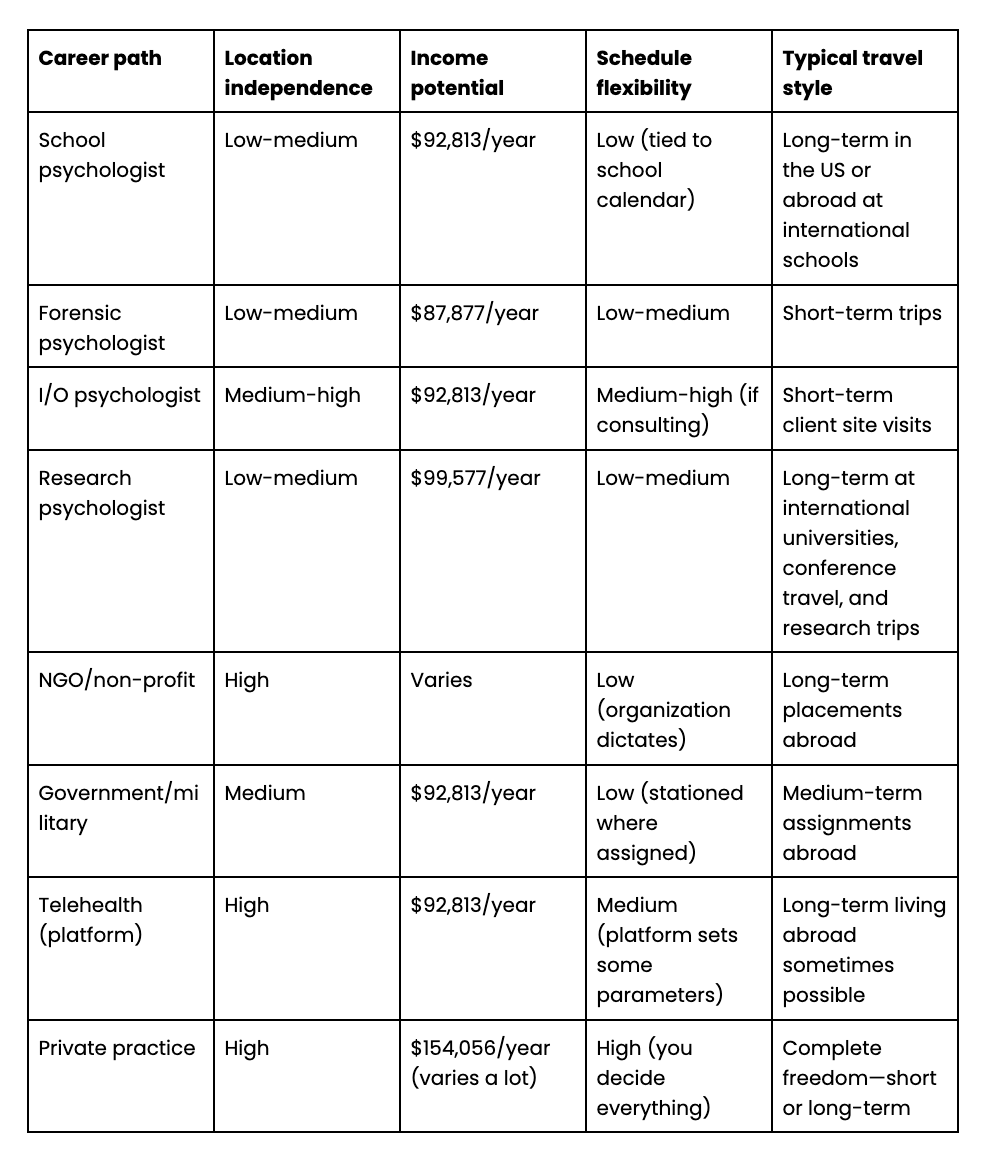
Comparing different travel psychologist career paths.
If you want ongoing freedom to move between countries and maintain that lifestyle long-term, running your own private practice gives you the highest location independence and earning potential!

The little family that I built while traveling and running my practice!
Personally, I've lived and worked from Morocco, Thailand, and Indonesia while maintaining a full US-based client caseload.
I got married, had a baby, took a 3-month maternity leave, and never had to pause my practice or ask anyone for permission to make those moves.
Learn how you can legally become a travel therapist, which licensing requirements you need to navigate, and more.
Why private practice often wins for long-term travel goals
I've been running my private practice while living abroad for over 3 years now after experiencing major therapist burnout.
I realize that this path isn't for everyone, but there are many advantages to consider:
You're not asking permission from an employer or organization every time you want to move or travel
You control your income, your schedule, and which clients you work with
You can build your practice around your life instead of constantly trying to fit life around work constraints
It's true location independence, not just location-dependent flexibility, where you're tied to one place at a time
It's sustainable for years or even decades, not just a short period before you have to return to a traditional setup
Private practice takes more work upfront because you're building a business.
But once your systems are in place and you have a steady client base, you have more freedom than any other psychology career path, IMO!
Ready to figure out the legal side of moving your practice abroad? Download my free guide: The 4 Legal Questions Every Therapist Must Answer Before Moving Abroad. It walks you through the licensing, insurance, and regulatory questions you need to answer!
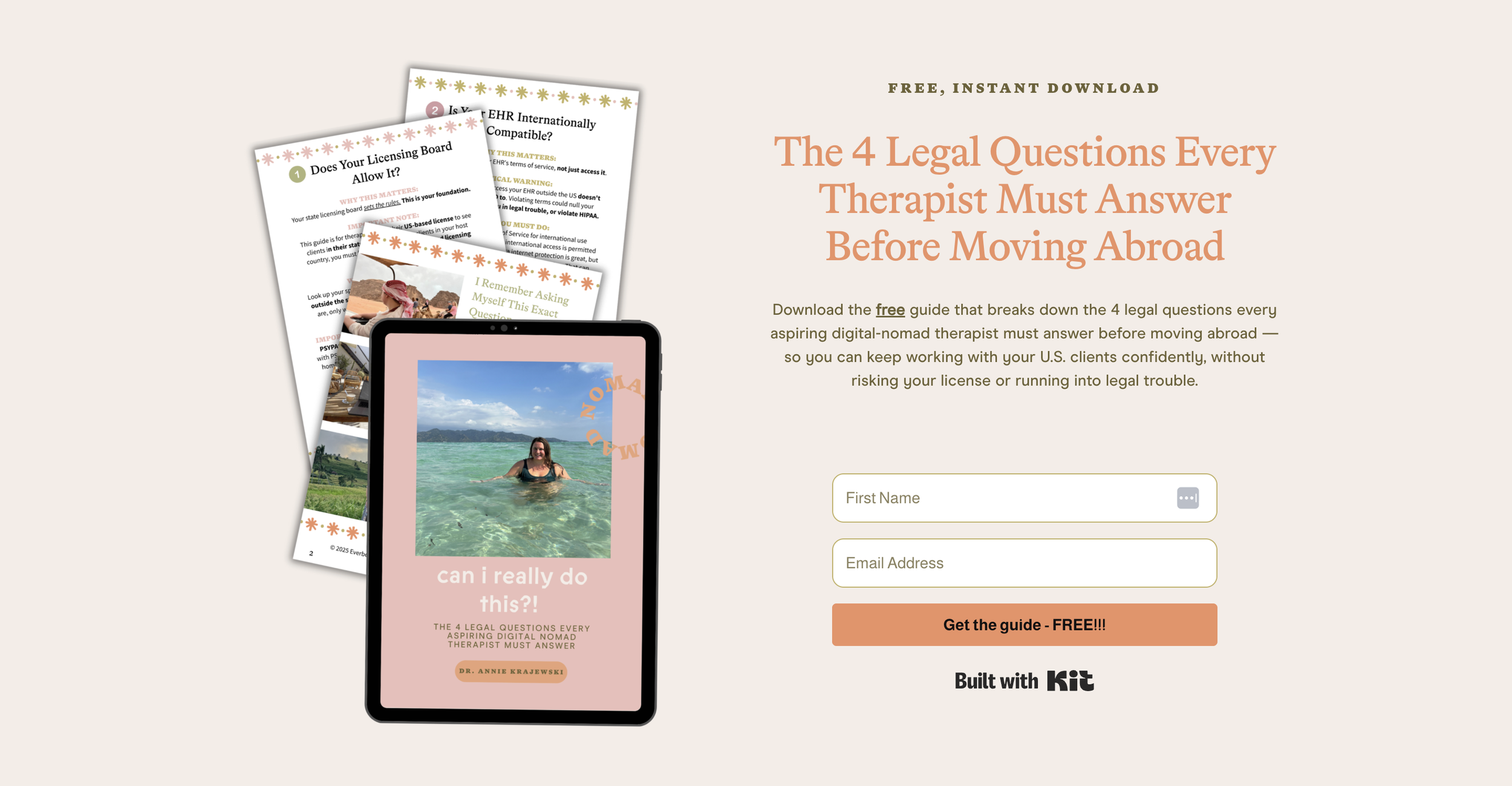
The 4 Legal Questions Every Therapist Must Answer Before Moving Abroad.
So, can psychologists work internationally?
The answer to this question is a resounding yes!
But there are a few different paths to choose from, depending on what kind of work you want to do and how much (and how internationally) you want to travel.
If you want maximum control over where you live and when you work, running your own private practice is usually the best option. It also allows you to truly travel the world instead of getting tied to one location for a job or assignment, or only getting to travel within the US.

Want step-by-step guidance on building a private therapy practice that allows you to travel the world? Join The Out of Office Therapist Village—a 12-month group coaching membership for therapists and psychologists who want to take their practice abroad!