Providing Therapy Online to Overseas Clients: Can You Do It?

Hi, I’m Dr. Annie Krajewski. I’ve been traveling the world and running my private practice full-time for 3+ years!
Can you provide therapy online to overseas clients? This is something many US-based therapists wonder about, and the answer is sometimes yes.
What do you do if you're in the US, but one of your clients has moved overseas as an expat and wants to keep seeing you? Or maybe someone living in another country, a citizen of that country, has reached out and asked to work with you. Can you do that?
The answers depend on a handful of specifics you'll need to research first, including your client's location and what your state board allows. So here's what you need to know!
This isn't legal advice! I'm a digital nomad therapist sharing what I've learned from building my own US-based private practice while traveling and from years of navigating these questions. Treat this as a starting point for your own research, and verify the specifics for your situation with your licensing board and, when needed, a professional who knows the relevant laws.
Can you provide therapy online to overseas clients as a US therapist?
Sometimes, yes.
Whether you can comes down to 1) who your client is and 2) where they're located, so let's get specific about WHAT you're actually asking.
This question usually points to one of two scenarios:
US citizens living abroad: Americans who've moved overseas and want to keep (or find) a US therapist
International clients: People who are citizens of other countries and live in those countries
The most important principle you'll want to think about is that US licenses are issued at the state level, and what governs your ability to practice is your client's physical location during the session.
It's not their citizenship or where they say they live.
A client who's a US citizen but sitting in Spain for the session is, for licensing purposes, in Spain. That same logic applies to clients who aren't US citizens: when they're physically in another country, your US license doesn't automatically give you the green light to practice there.
So, for any overseas client, you're really looking at two layers:
What your US licensing board says about practicing with a client who's outside your licensed state (and outside the US)
What the host country's laws say about a foreign therapist providing services to someone inside their borders
The rest of this post walks through both layers for each scenario, so you can figure out where your situation lands!
Providing online therapy to US citizens who live abroad
This question often comes up when you have an American client who's relocating overseas (or already has), and they want to keep seeing you. It makes sense, because you've built a relationship and they'd rather not start over with someone new!
However, your client being a US citizen doesn't create a loophole.
What's important is where they're physically located during the session. If that's in another country, then for licensing purposes they're in another country, not in their "home" state. Citizenship doesn't change that.
So, there are two things you'll want to check for: 1) US regulations and 2) the regulations of the country your client is living in.
US regulations
On the US side, most boards frame their rules around the client being located in a state where you hold a license. An overseas location falls outside that framing, which means that board guidance is often silent or unsettled on the question, and you may not get a clear yes or no.
You'll want to read your state's telehealth regulations closely and, if they don't address international situations, email your board, ask them, and keep their answer on file.
Foreign country regulations
On the host country side, many countries don't actively regulate or enforce against a foreign therapist serving a foreign national online. In plenty of cases, a US therapist seeing a US expat over video isn't a problem or on anyone's radar.
But this varies from country to country, and "probably fine" isn't the same as confirmed, so don't assume it without doing your homework for the specific country involved!
Providing online therapy to international clients
This scenario is for clients who are citizens of another country and living there, with no US ties. AKA, someone in France or Japan finds you online and wants to work with you!
With these clients, the bigger question is what the laws say in the country where they live, because you'd be providing services to that country's own resident inside their borders. Some countries are strict about who can offer mental health services and what those services can be called. Others are more relaxed.
The deciding factor is usually local regulation: as long as the country your client is in permits it, and your own state board doesn't prohibit you from practicing with clients outside your licensed states, you're generally on solid ground.
So, look into the mental health licensing rules for the country your client is in and check your own state board's stance on practicing with out-of-state and international clients.
Learn more about how a US therapist can work in Europe.
Things to check to legally provide therapy to overseas clients
Whichever scenario you're in, you'll want to confirm a few things before your first session with your overseas client:
Malpractice insurance: Email your provider and confirm in writing that your policy covers sessions with clients located outside the US, since not all do
HIPAA and data laws: You're still bound by HIPAA, and if your client is in the EU, you may also need to comply with GDPR, so use tools that keep you covered on both fronts
Emergency and duty-to-warn protocol: Gather local emergency contacts and resources for your client's location, so you know how to get help to them if a crisis happens
Time zones: Confirm the available session times are sustainable for you, since a client overseas may only be free during hours that fall in the early morning or late at night your time
Payment and currency: Check that your processor accepts payment from clients abroad, and make sure you understand any conversion fees
Compliant platform: Use video and other tools that meet HIPAA standards and work reliably across borders
These logistics will protect both you and your client down the road!
Will insurance cover online therapy for overseas clients?
Almost certainly no.
Insurance panels are built around US-based clients and US providers, and once your client is overseas, you're well outside what most panels will reimburse.
This is a big reason I recommend running a private pay practice vs taking insurance!
Going private pay frees you from insurance company location requirements and credentialing restrictions, which is the kind of flexibility you need when your clients (or you) are crossing borders. It also lets you set your rates around your expertise instead of an insurer's fee schedule.
What if YOU are the one who moves abroad?
Now let's flip the setup!

Moving abroad to eat delicious food!
Instead of your client being overseas, YOU are the one abroad while your clients are in the US, where you're licensed. This is a different situation, but the short version is that it's both possible and legal.
When your clients are in states where you hold a license, it doesn't matter (for licensing purposes) whether you're logging in from your home office or another country.
Your clients are still where they're supposed to be, and you're still practicing within your license. This is the setup I've built my own practice around for the last 3+ years while traveling full-time!
Becoming a digital nomad or a remote therapist has huge perks:
You can travel and live in places you've always wanted to experience
A lower cost of living abroad means your US income often goes much further
No office rent and no commute frees up both money and time
Your schedule gets built around your life, not the other way around
That said, there are a lot of moving pieces to line up, like confirming your state board allows you to practice from outside the US, making sure your malpractice insurance covers you abroad, sorting your visa situation, and managing time zones.
None of them is a dealbreaker, but you'll want to do some planning.
Get my 8-week checklist to move abroad as a digital nomad therapist
If moving abroad or traveling as a therapist sounds like the life you want, breaking it into smaller steps makes the whole thing feel a lot more doable!
If you want a week-by-week plan that walks you through the most important things to consider, download my free guide: Your 8-Week Checklist to Become a Digital Nomad Therapist!
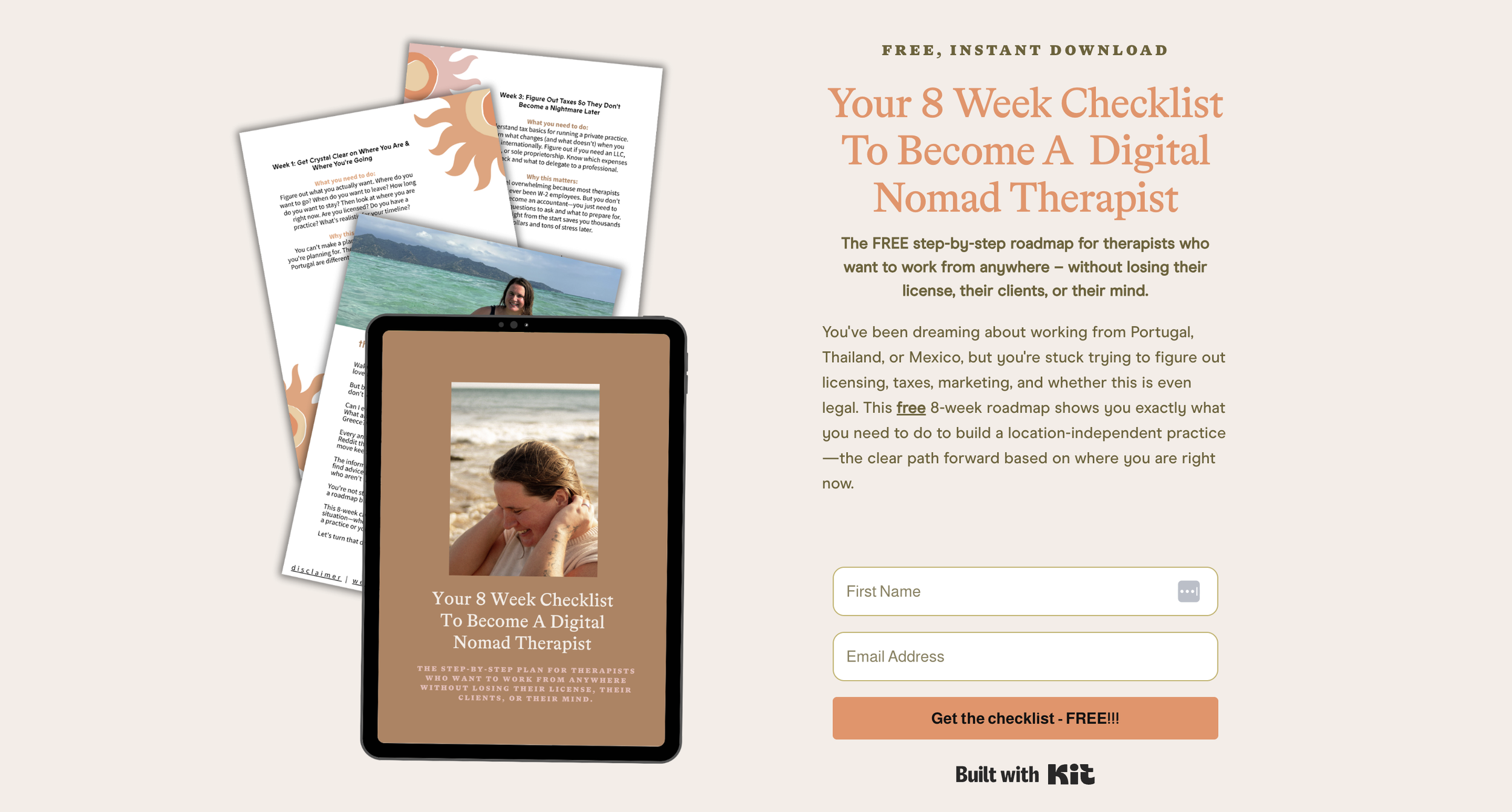
Your 8 Week Checklist to Become a Digital Nomad Therapist.
FAQs
Can a US-licensed therapist legally see clients in other countries?
Sometimes. Your US license is issued at the state level and is tied to where your client is physically located during the session. When that location is another country, your license doesn't automatically authorize you to practice there. Whether you can comes down to two things: what your state board says about practicing with clients outside your licensed states, and what the laws are in the country where your client is located. Make sure to check both!
Does HIPAA still apply when I'm working internationally?
Yes. HIPAA follows you and your practice regardless of where you or your client are physically located, so you need HIPAA-compliant tools and habits no matter where you're working from. If your client is in the EU, you may also have GDPR to account for, which adds its own rules around handling personal data.
Will my malpractice insurance cover sessions with overseas clients?
Maybe, but you don't want to assume that it will! Some policies don't automatically cover sessions when your client is located outside the US, but many do. Email your provider, describe your arrangement, and get written confirmation that you're covered before your first session. If your current policy doesn't extend to it, it's often a pretty easy switch to one that does.
Does my US license stop working if I move abroad myself?
No. Your license stays valid as long as you keep it active and in good standing, and you can keep seeing clients who are located in the states where you're licensed even while you're living overseas. What you'll want to confirm is whether your state board has any rules about the provider being located outside the US, since a small number do. But most care about where your client is, and not where you are.
Get your Roadmap to a Nomad Practice
If you've read this far and you're feeling the pull to build a location-independent practice of your own, the Roadmap to a Nomad Practice helps you get there!
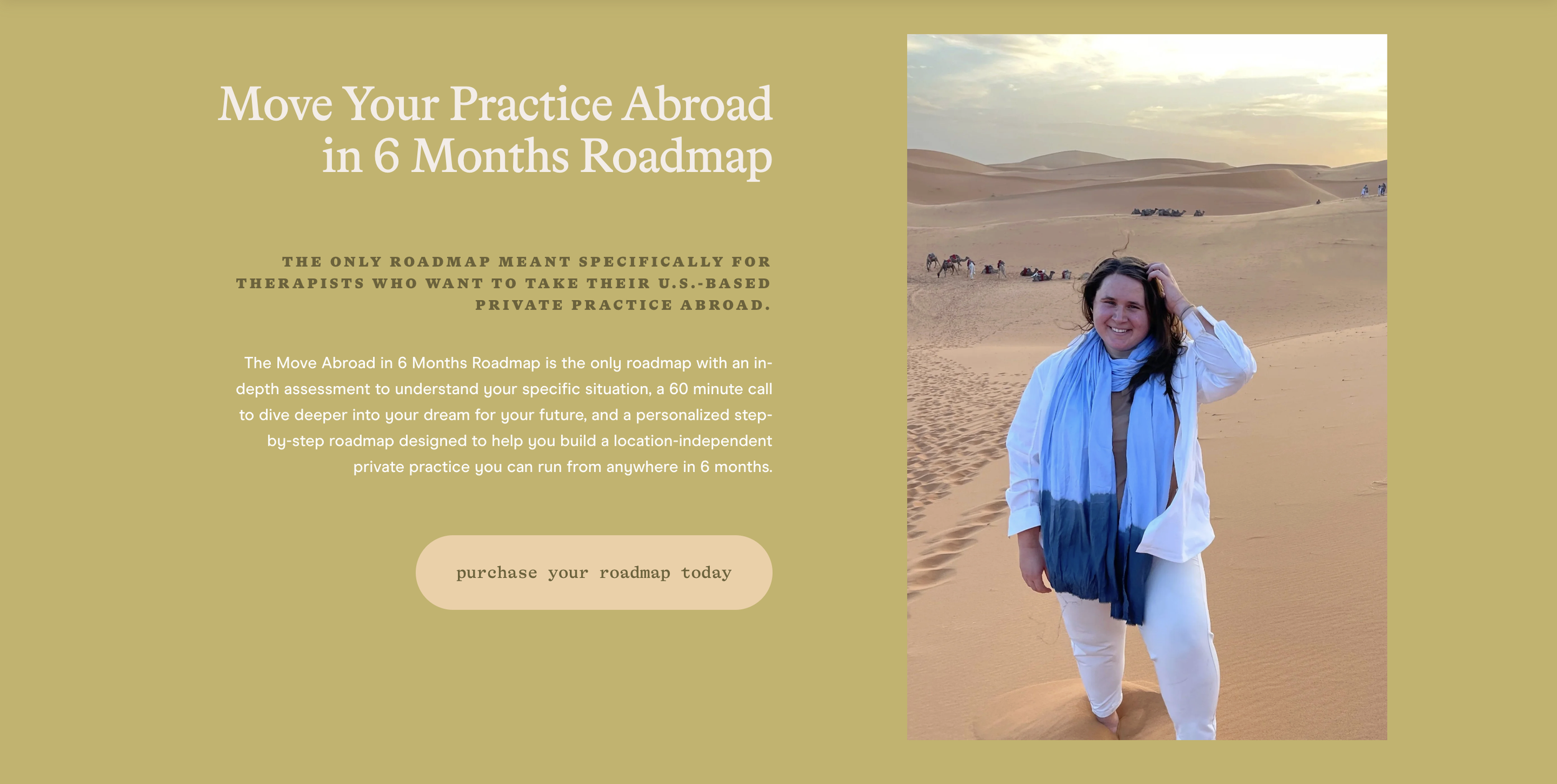
Move your practice abroad with this roadmap!
It's a personalized plan for therapists who want to take their US-based private practice abroad.
Here's what's included:
A pre-call assessment to map out your specific situation
A 90-minute 1:1 strategy session with me to dig into your goals
A custom Notion roadmap with your personalized, month-by-month plan
7 days of email support after you receive it
Your Roadmap to a Nomad Practice will take you from "someday" to a clear, step-by-step plan you can follow to run your practice from anywhere within 6 months.
Get your customized Roadmap to a Nomad Practice today!