If you’re trying to figure out how to become a telehealth therapist, you probably have a browser full of open tabs and more questions than answers. Do you need extra training? Should you sign up with BetterHelp? Can you legally see clients from home, or from somewhere a lot sunnier?

Hi, I’m Dr. Annie Krajewski. I’ve been traveling the world and running my private practice full-time for 3+ years!
I remember that feeling so well. I didn’t start as a digital nomad therapist. I was seeing clients in a traditional setup and had no idea where to even begin. Now I run a full, private-pay telehealth practice for US clients, and I’ve done it while living in Morocco, Thailand, Indonesia, and Brazil!
The short answer is that you’ll need a graduate degree and a state license, just like any other therapist. From there, you add a HIPAA-compliant tech setup, learn where you’re allowed to practice from, and decide whether you want to work for a platform, join a group practice, or build your own private practice.
This guide walks you through each option and the 7 steps to get there, so you can build a practice that gives you more freedom and joy.
What is a telehealth therapist?
A telehealth therapist is a licensed mental health professional who provides therapy through technology. That usually means secure video sessions.
You’ll see “telehealth,” “teletherapy,” “online therapy,” and “remote therapy” used pretty interchangeably. The main difference is that telehealth is the term licensing boards, insurance companies, and state laws use, so you’ll see it all over your state’s rules once you start your research.
Telehealth went from a niche option to a normal part of mental health care in a very short amount of time. Before the pandemic, telehealth accounted for roughly 1% of mental health visits. By April 2020, that number spiked to over 85% before settling at the current 55-60% range.
Benefits of being a telehealth therapist
Telehealth gives you many perks that are hard to get with an office-based practice. Here are a few of my favorites:
You can see clients anywhere in the state(s) where you’re licensed, including rural areas where in-person therapists are hard to find
Your overhead drops because you’re not paying rent, utilities, or furniture costs for an office
Your schedule gets more flexible, since there’s no commute between you and your next session
Clients face fewer barriers to getting to sessions, which can mean fewer cancellations and more consistent care
You get location freedom, whether that means working from home or another country
For me, location freedom changed everything. Telehealth is the reason I could build a practice around travel and cure my horrible therapist burnout.
Ways to become a telehealth therapist
There’s more than one path to working as a telehealth therapist. Let’s go through the three most common options so you can see which one fits your goals.
1. Join a telehealth platform
Companies like BetterHelp and Talkspace connect licensed therapists with clients who want online sessions. You apply, get approved, and the platform sends clients your way.
For a lot of therapists, platforms feel like an easy first step, and they do have some upsides:
You don’t have to market yourself, because the platform handles client matching
Billing, scheduling, and video tech are (mostly) taken care of for you
You can usually start seeing clients fairly quickly once you’re approved
That said, the downsides are pretty significant:
Pay per session is usually much lower than what you’d charge in private practice
You often have little control over who you’re matched with or how your caseload grows
Some platforms include client messaging between sessions, which can make it hard to fully log off
Platform policies can limit where you’re allowed to work from, and those policies can change at any time
Platforms can work as short-term income or a way to get comfortable with video sessions. But if your goal is long-term freedom, it’s hard to build that on someone else’s terms.
2. Work for a virtual group practice
Group practices have gone remote in a big way. Recent data shows that 44% of new group practice hires were fully remote clinicians. In this setup, you’re an employee or contractor for a practice that handles a lot of the business side for you.
This can be a great middle ground, especially if you want support:
You get a steady flow of referrals without doing your own marketing
You often have access to supervision, consultation, and a team of colleagues
Admin tasks like billing and insurance credentialing are usually handled for you
The trade-off is control:
The practice keeps a percentage of every session fee, so you earn less per client than you would on your own
Many group practices bill insurance, which can tie you to a specific state or require you to stay in the US
You may have to follow set schedules, minimum caseload requirements, or rules about where you work from
If you’re newly licensed or want a team around you, a remote group practice can be a solid stepping stone. Just ask about their provider location policies upfront so nothing catches you off guard later!
3. Start your own telehealth private practice
This is the path I took, and it’s the one I recommend for therapists who want true freedom.
Running your own practice means you’re the business owner. You set your rates, choose your niche, decide your hours, and pick where you work from.
It’s also becoming much more common. According to the American Psychological Association, 19% of psychologists practice fully remotely, and another 69% offer a hybrid mix of virtual and in-person sessions.
To be fair, private practice comes with (a lot) more responsibility. You’ll be in charge of:
Marketing your practice and finding clients
Choosing your tech, setting up your business, and staying compliant
Handling your own taxes, liability insurance, and paperwork
That can feel like a lot at the beginning (it definitely did for me!). But this is the only option where every decision is yours. You’re not waiting on a platform to approve your schedule or a group practice to sign off on something you want to do.
And if you go private pay, you can set rates that reflect your expertise and keep your practice free from insurance panel rules and requirements.
How to become a telehealth therapist: 7 steps
Becoming a telehealth therapist starts the same way as becoming any therapist. You’ll need a graduate degree in counseling, psychology, social work, or marriage and family therapy, as well as supervised clinical hours and a state license. There’s no separate “telehealth degree” you have to go get!
Where things change is the logistics. Seeing clients over video means thinking through licensing rules, tech, safety planning, and how clients will find you when you don't have a physical office. Here's what to expect.
1. Get licensed (and look into licensing compacts)
Your license decides which clients you can see. As a telehealth therapist, you can work with clients who are physically located in a state where you’re licensed at the time of their session.
If you want to reach clients in more than one state, licensing compacts can make that a lot easier. Compacts let you practice in other member states through your home state license, so you don’t have to apply for a full license in every state. They include:
PSYPACT covers psychologists and includes 40+ participating states for telepsychology.
The Counseling Compact has passed in about 40 states, and a growing number of them are now issuing privileges to practice for licensed professional counselors.
The Social Work Licensure Compact has passed in dozens of states, but it isn’t issuing multistate licenses yet.
Compacts are rolling out state by state, so check the official PSYPACT and Counseling Compact sites for the latest list.
2. Learn your state’s telehealth rules
Every state has its own telehealth laws, and your licensing board may have extra rules on top of those. As you research, look for:
Whether you need a separate informed consent form for telehealth
Whether your board requires telehealth training or continuing education
Any rules about where you have to be located while you see clients
Requirements for verifying a client’s identity and location
If anything is unclear, email your board and save their reply.
Learn more in my FREE guide: The 4 Legal Questions Every Therapist Must Answer Before Moving Abroad.
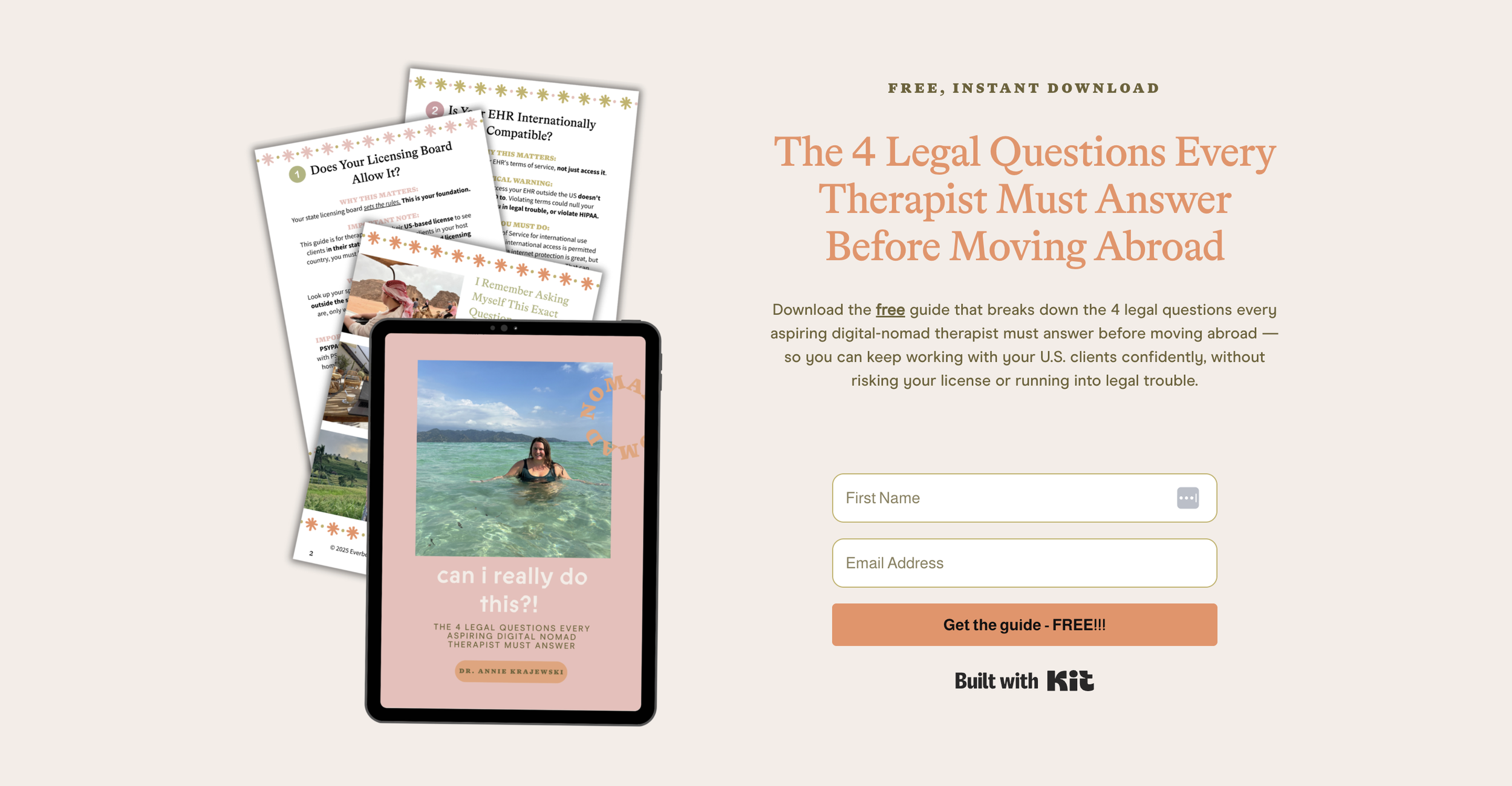
The 4 Legal Questions Every Therapist Must Answer Before Moving Abroad.
3. Set up the business side of your practice
If you’re going the private practice route, you’re starting a small business. This means you'll want to:
Register your business (often as an LLC) and get an EIN from the IRS
Open a separate business bank account so your practice income stays organized
Get an NPI number if you plan to bill insurance or give clients superbills
Find malpractice insurance that explicitly covers telehealth services
Not every malpractice policy covers telehealth, so read the fine print or ask the insurer questions. If you add new states or start working from a new location, let them know so your coverage stays up to date.
4. Choose HIPAA-compliant tech
Not every video tool is safe for therapy. Any platform that handles client information needs to be HIPAA-compliant and willing to sign a Business Associate Agreement (BAA) with you.
Your basic telehealth tech stack should include:
An EHR for notes, scheduling, and billing (I love Jane, and you can use my code DIGITALNOMAD1MO to get one month free!)
A secure video platform, either built into your EHR or through a HIPAA-compliant plan like Zoom for Healthcare
A VPN to protect your connection when you’re on shared or public wifi
Compliant tools protect your clients’ private health information and keep you on the right side of HIPAA.
5. Create a telehealth safety plan
When you’re not in the same room as your client, you need a plan for what happens if they’re in crisis or your connection drops mid-session.
Before your first session with a new client, make sure you have:
The client’s physical address for each session, confirmed at the start of every appointment
An emergency contact the client has agreed you can reach if needed
Local crisis resources and the nearest emergency room for wherever the client is located
A backup plan, like a phone number to call, if the video cuts out
Include all of this in your telehealth informed consent so clients know what to expect. It helps them feel safe, and it helps you feel confident too!
6. Set up your workspace and internet
Your clients deserve privacy online. That means a quiet room with a door that closes, where no one can overhear your sessions.
A dropped call is frustrating for everyone, so I always recommend having a backup connection. A phone hotspot is a good option, and a portable router or Starlink can help if you’re somewhere more remote.
Small details like a tidy background and eye-level camera also make a big difference in how present you feel to your clients.
7. Build your caseload
Even the most skilled therapist needs clients to know they exist! Once your practice is set up, filling your caseload comes down to good marketing. Focus on:
A website that clearly explains who you help and that you offer telehealth in your licensed state(s)
A directory profile, like Psychology Today, with the online therapy option turned on
Blog content and SEO so clients can find you when they search for a therapist in your niche
Referral relationships with other therapists, doctors, and providers who serve your ideal clients
When you know who you help, you can speak to their struggles in words that feel familiar to them.
Where can you see clients as a telehealth therapist?
You can see clients in any state where you hold a license or a compact privilege. What matters is where the client is physically located during the session.
So if you’re licensed in Texas and your client lives in Texas, you’re all set. But if that same client spends the summer at their family’s place in Maine, you’d typically need a Maine license (or a compact privilege that covers Maine) to keep seeing them while they’re there.
Seeing clients who live outside the US is a separate conversation, since you may need to follow that country’s laws too.
Most licensing boards focus on where your clients are, not where you are, which means you can usually see clients from home, another state, or even another country. As long as your board doesn’t restrict provider location, your "office" can be wherever you are!
Can you travel as a telehealth therapist?
Between licensing rules, client locations, and conflicting advice in therapist forums, it can seem like traveling and running a therapy practice just aren’t meant to go together, but they definitely can.
Since your license is tied to where your clients are located, you can spend time in a different state or even move abroad while you keep seeing your US-based clients. It does take some planning upfront, but traveling as a telehealth therapist is a very achievable goal.
Your career doesn’t have to keep you in one place for the rest of your life. Personally, my telehealth practice has come with me to Morocco, Thailand, and Indonesia, and I’ve kept a full caseload.
Want a step-by-step plan to make it happen? Download my free guide, Your 8-Week Checklist to Become a Digital Nomad Therapist.
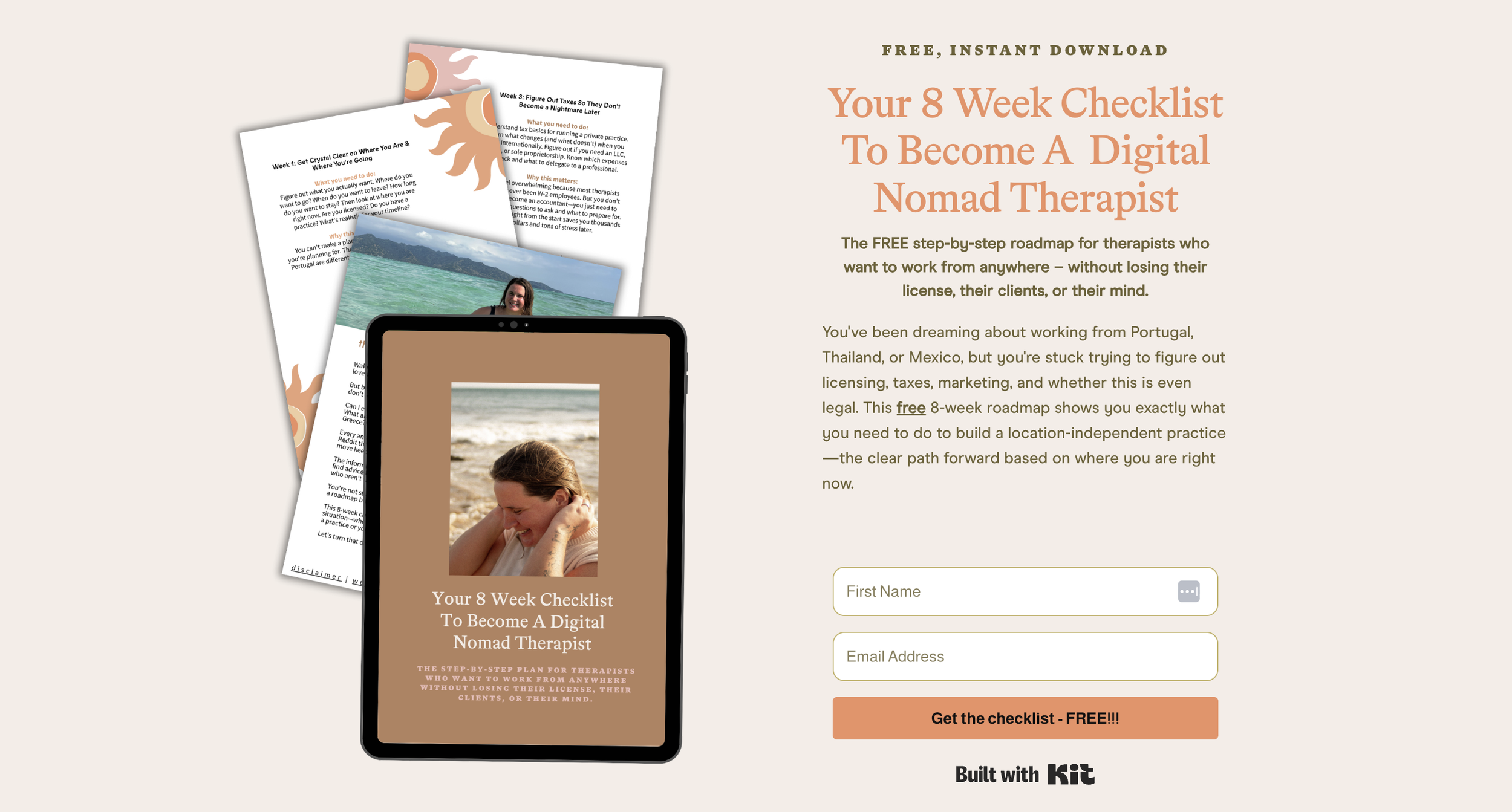
Your 8-Week Checklist to Become a Digital Nomad Therapist.
FAQs
What degree do I need to be a telehealth therapist?
You need the same degree as any licensed therapist, which is usually a master’s degree in counseling, social work, or marriage and family therapy, or a doctorate in psychology. After graduate school, you’ll complete supervised clinical hours and pass your licensing exam. Telehealth doesn’t add any extra degree requirements.
Do I need a special certification to provide telehealth?
Not in most cases. Some states require telehealth-specific training or continuing education, so check your board’s rules. Optional credentials like the Board Certified-TeleMental Health Provider (BC-TMH) can help you build confidence and credibility, but they aren’t required to start seeing clients online.
Can I take insurance as a telehealth therapist?
Yes, many insurance plans cover telehealth therapy. Just know that panels can have rules about where you’re located while you work, which can limit your ability to travel. That’s one reason I run a private pay practice.
Start building your life of freedom as a telehealth therapist
You’ve spent years learning how to help other people build lives that feel good to them. You deserve that same freedom in your own life, whether that means more time with your family, fewer burned-out weeks, or finally booking the trip you keep putting off.
You don’t have to figure it all out on your own. The Out of Office Therapist Village is a 12-month group program that gives you step-by-step guidance, live support, and a community of therapists building location-independent practices right alongside you.

The Out of Office Therapist Village.
Learn more about the OOO Therapist Village and start building the practice (and the life!) you’ve been dreaming about!